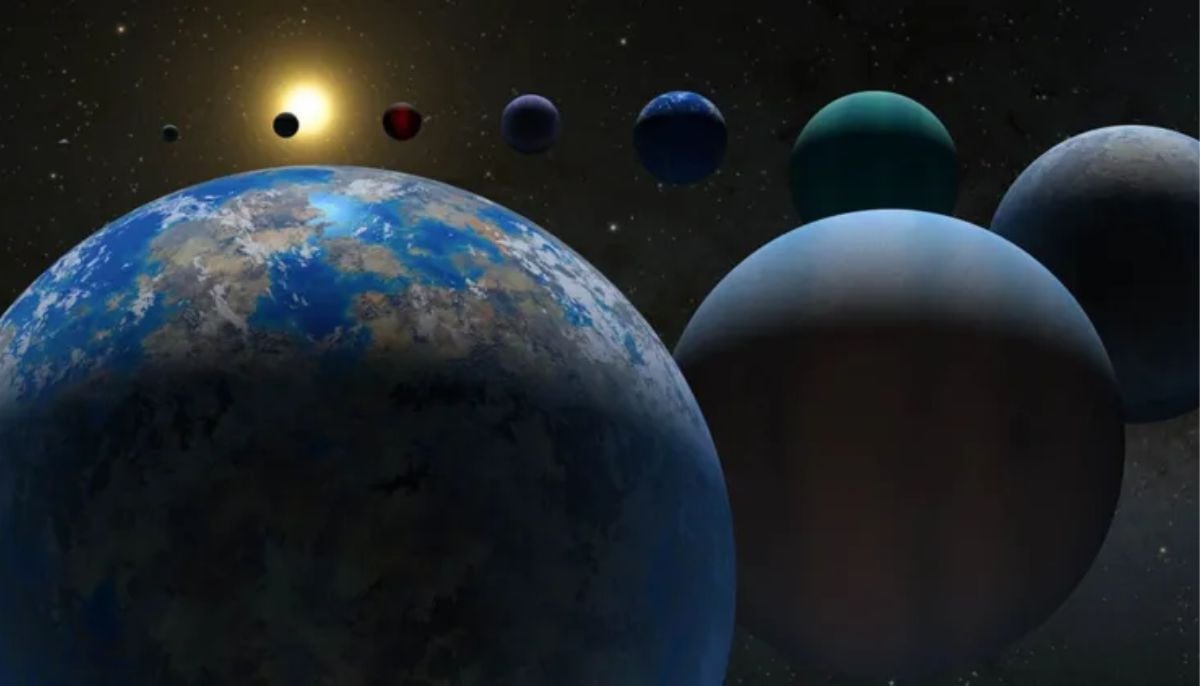
In a recent breakthrough, astronomers have identified 45 new rocky exoplanets that could harbor and support extraterrestrial life.
The researchers also mentioned a more ‘restrictive’ list of 24 planets that meet even stricter habitability assumptions.
About 6,000 exoplanets have been discovered so far, but many of them cannot harbor life due to unsuitable conditions and temperature conditions.
These newly identified planets are in the habitable zone, which is the orbital region around a star where temperatures are quite suitable for harboring any life.
Examples of these habitable exoplanets include TRAPPIST-1, TOI-715 b, LHS 1140 b, Kepler 186f and Proxima Centauri b.
“Like Project Hail Mary This illustrates so beautifully that life could be much more versatile than we currently imagine, so figuring out which of the 6,000 known exoplanets would be most likely to host aliens like Astrofage and Taumoeba – or Rocky – could be crucial, and not just for Ryan Gosling,” said Professor Kaltenegger, who led the research.
“Our paper shows where you would have to travel to find life if we were ever to build a ‘Hail Mary’ spacecraft,” he added.
The most intriguing exoplanets
Of all the potential candidates, some planets are more intriguing when it comes to supporting extraterrestrial life. The most exciting on the list is the Trappist-1 system. The system 40 light-years away contains four promising planets (d, e, f and g).
TOI-715 b and LHS 1140 b have emerged as promising candidates for near-term research due to their size and orientation.
These planets are capable of receiving levels of starlight equivalent to the sunlight that Earth receives. The examples include: RAPPIST-1 e, TOI-715 b, Kepler-1652 b, Kepler-442 b and Kepler-1544 b, along with planets such as Proxima Centauri b, GJ 1061 d, GJ 1002 b and Wolf 1069 b.
The researchers also look at eccentric planets with oval-shaped orbits and planets at the far inner or outer edges of the habitable zone to see how much heat or cold life can actually tolerate.
According to co-author Abigail Bohl of Cornell University, “We can use our solar system as a reference to look for exoplanets that receive stellar energy between what Venus and Mars receive.”
“Observing these planets can help us understand when habitability is lost, how much energy is too much, and which planets remain habitable — or may never have been,” Bohl added.
Using data from the Gaia mission and NASA’s Exoplanet Archive, the study was titled Exploring the limits of habitability: a catalog of rocky exoplanets in the habitable zonealso prepared a list for future observatories, including
- JWST
- Nancy Grace Roman Space Telescope (2027 launch)
- Extremely large telescope (in 2029)
- Habitable Worlds Observatory (expected to launch in the 2040s)
- Proposed Large Interferometer For Exoplanets (LIFE) project