Storms on Earth can be powerful, but new research suggests they are no match for the extreme forces at work on Jupiter, where lightning can reach dizzying intensity.
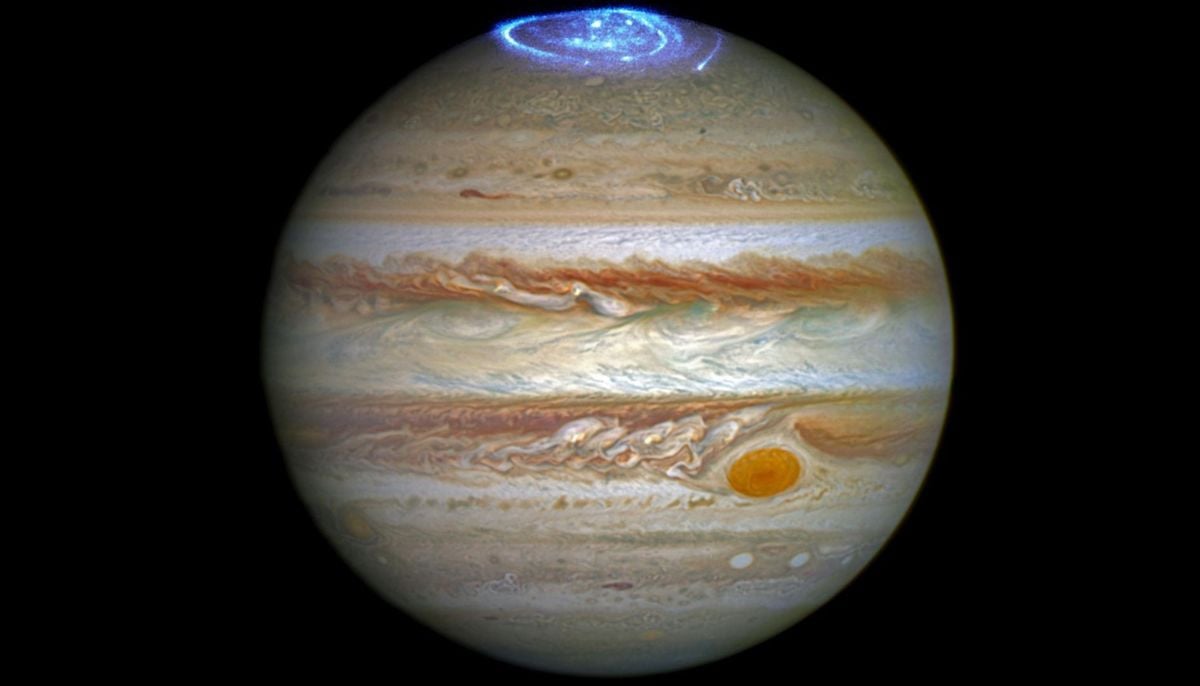
A study published March 20 in AGU Advances shows that lightning on Jupiter can be more than 100 times stronger than typical ground bolts and in some cases can be up to a million times more powerful. The findings provide new insight into the violent weather systems of the solar system’s largest planet.
Juno data reveals hidden lightning power
Scientists had basic knowledge about lightning on Jupiter before 2016, which depended on their nighttime observations showing only the strongest lightning strikes, which scientists considered comparable to Earth’s extremely rare superbolts. But NASA’s Juno spacecraft, which has been orbiting Jupiter since 2016, has brought about this transformation.
Juno represents a new development in space exploration because it allows scientists to study lightning radio signals, which scientists use to determine the energy levels of thunderstorms that occur even when clouds block sunlight. The method produced results showing all components of the planet’s electrical activity.
Scientists conducted their research on the individual stealth superstorms that occurred during the calm periods of 2021 and 2022 to monitor the associated lightning activities. They documented a total of 300 lightning flashes, which produced an average of three lightning strikes per second.
The research showed that the lightning flashes varied in strength. While some flashes were similar to those on Earth, others were a hundred times stronger. However, due to differences in measurement techniques and the use of different wavelengths, there is also some uncertainty in the data, and the strongest flashes can be up to a million times stronger than lightning on Earth.
The difference between Earth and Jupiter lies in the atmosphere of the two planets. While Earth has a predominantly nitrogen atmosphere, Jupiter has a predominantly hydrogen atmosphere.
Because moist air on Jupiter is heavier, the energy required to develop the storm is much higher. When the storm develops, the energy is released in the form of stronger lightning. The storms on Jupiter are also up to 100 kilometers high, much higher than those on Earth.
Scientists believe the underlying process that causes lightning, which involves charged water droplets and ice particles, is similar on both planets. However, the enormous size and energy on Jupiter make the storms fundamentally different.