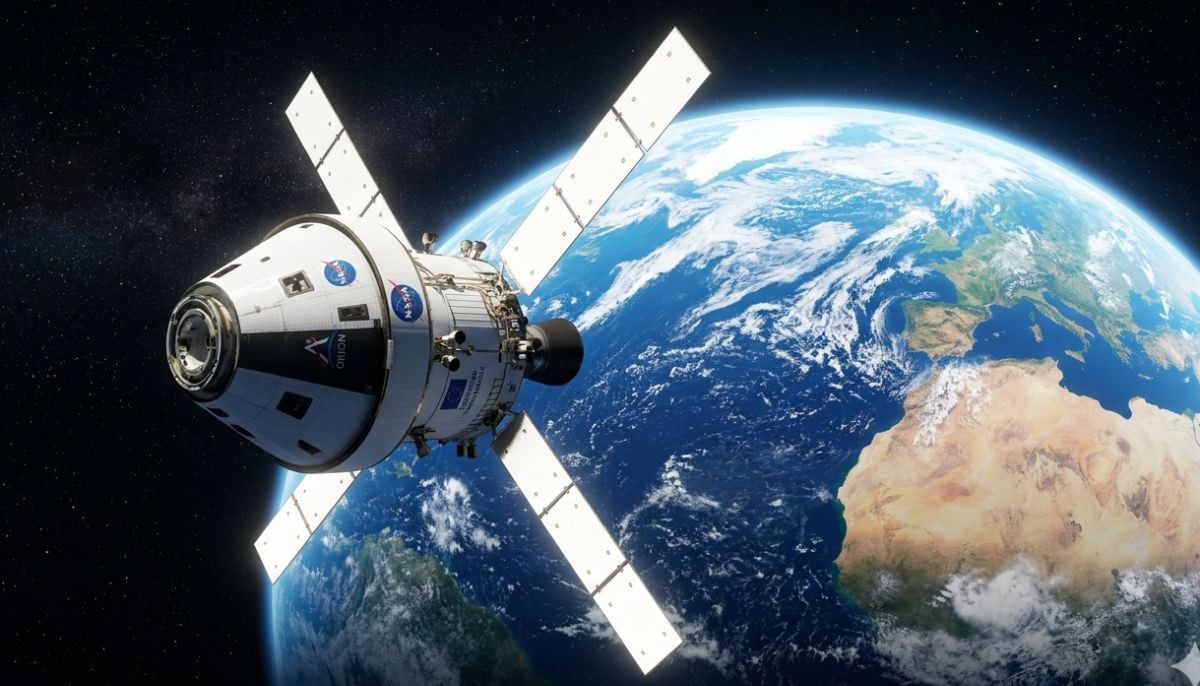
The four astronauts aboard the Orion spacecraft have successfully left Earth’s orbit and are now headed to the moon. This was achieved in remarkable fashion via a five-minute, 55-second engine start known as Translunar Injection (TLI). NASA officials confirmed that the maneuver was executed flawlessly. In keeping with its historical significance, this is the first time humans have traveled beyond Earth’s orbit since the Apollo 17 mission in 1972.
The crew was excited about their journey, as Canadian astronaut Jeremy Hansen reported that the crew is feeling pretty good as they watch the Earth shrink in the distance. Hensen makes history as the first non-American to travel to the moon, as reported by the BBC. The crew expressed deep gratitude to the thousands of people whose hard work and perseverance made the mission possible, stating that humanity has once again proven its capabilities.
In this regard, he said: “Humanity has once again shown what we are capable of. It is your hopes for the future that now take us on this journey around the moon.”
The Trans-lunar injection (TLI) launched the spacecraft on a journey that is expected to take the crew further from Earth than anyone has ever been: more than 7,600 kilometers beyond the moon. In line with NASA estimates, this trajectory will pass the record set by Apollo 13 in 1970, depending on the fine details of the timing and trajectory. It is pertinent to note that TLI is not a point of no return for Orion, even after the great burn to the moon.
To deal with emergency situations, a U-turn maneuver remains the fastest way home in the first 36 hours after the TLI. As Orion moves further into the cosmos, the views through the windows will become more and more inspiring. The Earth shrinks to a small blue and white marble behind them, while the moon grows from a bright disk into a heavily cratered world that fills the frame. As the mission progresses towards day 6, Orion will sail past the moon, where the astronauts will witness a total solar eclipse.
This mesmerizing view occurs as the Moon passes directly in front of the Sun, completely obscuring its bright face and revealing a shimmering halo, while the Earth hangs off to one side.