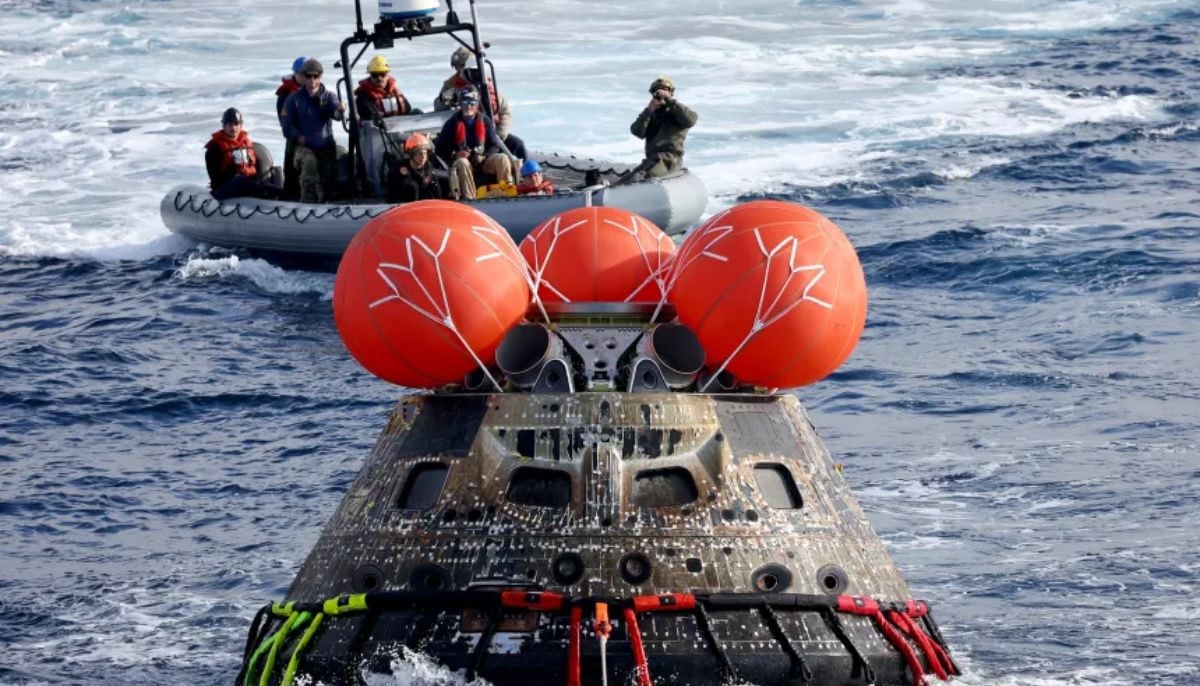
The NASA Artemis II mission is currently in its final hour with an Orion capsule landing scheduled for Friday in the Pacific Ocean off the coast of San Diego.
Shortly after landing, NASA and the military will help them get out of the capsule and fly them to a recovery ship.
Undoubtedly, the mission has been a historic success, marked by a record-breaking lunar flight at a greater distance from Earth, but the return ‘to terra firma’ is considered the most dangerous and critical phase yet to be overcome.
Some primary technical and physical challenges can hinder the successful ‘return’ of crew members. NASA’s Associate Administrator Amit Kshatriya explained during a briefing Thursday, “When we can start celebrating is when we have a crew safely in the ship’s medbay.”
“That’s really the moment where we can let the emotions take over and, you know, talk about success,” he added.
Heat shield integrity
The stakes for the Artemis II mission are very high and disturbing. In 2022, the space agency witnessed unexpected erosion of the Orion heat shield during the 2022 Artemis I test flight.
For a successful splashdown, the integrity of the thermal protection system must remain intact. During reentry into Earth’s atmosphere, the spacecraft must withstand temperatures of 5,000 F, about half the temperature of the Sun.
At that moment, the capsule will travel at a tremendous speed of 34,965 feet per second, or more than 30 times the speed of sound. At this point, a heat shield, intended to protect the crew through ablation, would have to erode the material to dissipate the heat.
To ward off the potential risks, NASA has changed the re-entry path. “We have a lot of confidence in the system and the heat shield and the parachutes and the recovery systems that we’ve put together,” Kshatriya said.
Communication failure
Another problem is a momentary loss of communication during the splashdown trip. As Orion moves through the atmosphere, the intense heat will ionize the air around the capsule and create a literal envelope of plasma. Because the plasma shield is impermeable to radio waves, it cannot maintain any communications.
For approximately 16 minutes, the crew will have a total communications blackout with Mission Control.
During this lull, the spacecraft must rely entirely on the onboard autonomous flight computers to perform critical roll maneuvers and control.
Parachute ballet
As Orion descends, a series of parachutes slow him down. There are a total of 11 parachutes, which are deployed in stages, at specific points during the descent. The required sequence must be followed to ensure error-free execution of capsule deceleration.
The nose cap should be blown off cleanly and two small slides should be deployed to stabilize the rotation of the capsule. Three enormous slides must unfold gradually to prevent them from snapping under the initial tension.
If all goes according to plan, the Artemis II astronauts will successfully return home, along with their families and loved ones.