In a record-breaking discovery, scientists have found a hidden star in an area where dust should not exist.
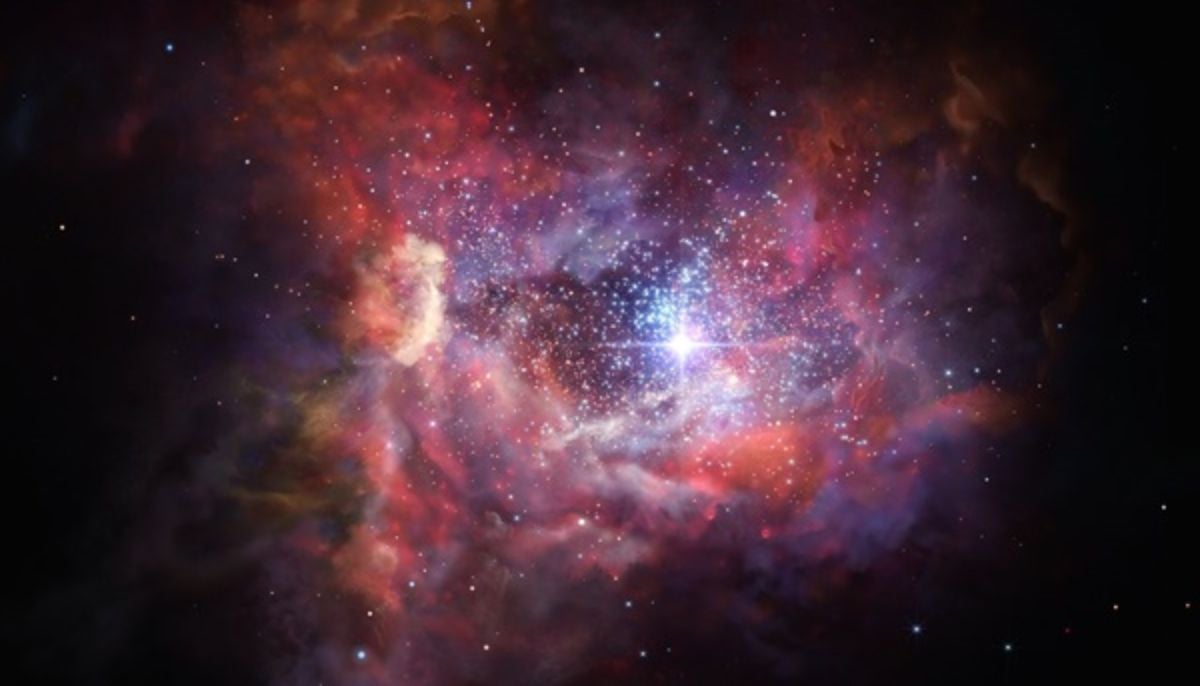
Kappa Tucanae A has long been a mystery to astronomers. The region is surrounded by dust whose temperatures have reached more than 1,000 degrees Fahrenheit.
Under such extreme conditions, the existence and survival of dust is a mystery to astronomers. It should evaporate or be pushed away by the star’s radiation.
Researchers at the University of Arizona’s Steward Observatory using the MATISSE instrument have detected a stellar companion star orbiting Kappa Tucanae A and located 70 light-years away from Earth.
This recent discovery published in The astronomical magazine gives researchers a rare but natural laboratory for in-depth analyzes of hot exozodic dust, as this type of dust poses a major obstacle in the search for Earth-like planets around the stars.
Such hot and exozodic dust also poses a major problem for NASA’s future Habitable Worlds Observatory (HWO), planned for the 2040s.
“If we see dust in such large quantities, it must be replaced quickly, or there must be some kind of mechanism that extends the life of the dust,” said Thomad Stuber, the study’s lead author.
The record finding also changes the way scientists look at the entire system. Rather than being a simple mystery, Kappa Tucanae A now serves as a basis for studying extreme stellar interactions.
According to Steward Observatory Associate Astronomer Steve Ertel, co-author of the study, “It is basically impossible that this companion is not connected in some way to dust production. It must interact dynamically with the dust.”
In addition to the exploration of new planets, the Kappa Tucanae A system paves the way for understanding the cosmic dust, its origin, composition and the star’s interaction with the dust.
“Since the Kappa Tucanae A system has been observed many times before, we didn’t even expect to find this companion star,” says Stuber.
He continued: “This makes it even more exciting to now have this unique system that opens up new avenues to explore the enigmatic hot exozodiacal dust.”