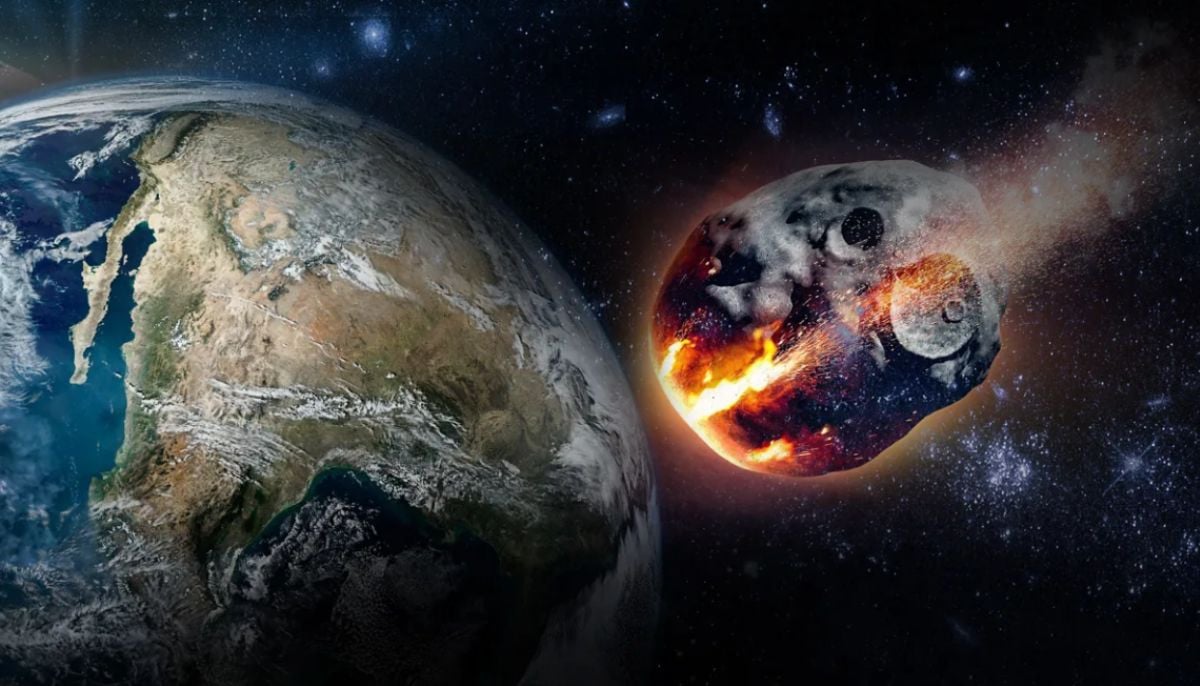
A surprising discovery has been made by the Planetary Defense Team who have detected the 40,000th Near-Earth Asteroid (NEA), whose path is dangerously close to our planet’s trajectory in the solar system.
First of all, there’s a lot more to explore and track as it gets closer to Earth. It can be visible to the naked eye from parts of Europe, Africa and Asia. This event is a great opportunity to study the 340-meter-high space rock, which will shine like a moving star in the night sky.
This marks one of the NEAs, 99942 Apophis, which was discovered in 2004 and is expected to arrive on Friday, April 13, 2029.
The European Space Agency (ESA) is monitoring the asteroid in collaboration with the Japanese Aerospace Exploration Agency (JAXA).
Apophis’ upcoming approach is an intriguing event. The asteroid, with a diameter of about 375 meters, will pass within 32,000 km of Earth – only about 10 percent of the distance to the moon.
NASA has confirmed that it will pass us safely at a distance ten times closer than the moon.
A cosmic giant will pass overhead, and scientists are closely watching how Earth’s gravity will yank Apophis from its current path.
If it had passed through a ‘gravitational keyhole’, it could have returned on a direct collision course with Earth in 2068. While these odds were once thought possible, scientists have now largely ruled out this doomsday scenario.
2029 is not just a meeting; it will be a cosmic opportunity to explore whether it can ultimately save the planet.
According to the USA Herald, the next four years are crucial. They should not be treated as a waiting period, but as a testing phase that requires internal structural analysis and contingency planning.
Nevertheless, the December 2028 through April 2029 observation window will be critical not only for studying Apophis, but also as a period for validating the planetary defense assumptions that hold in the real universe.