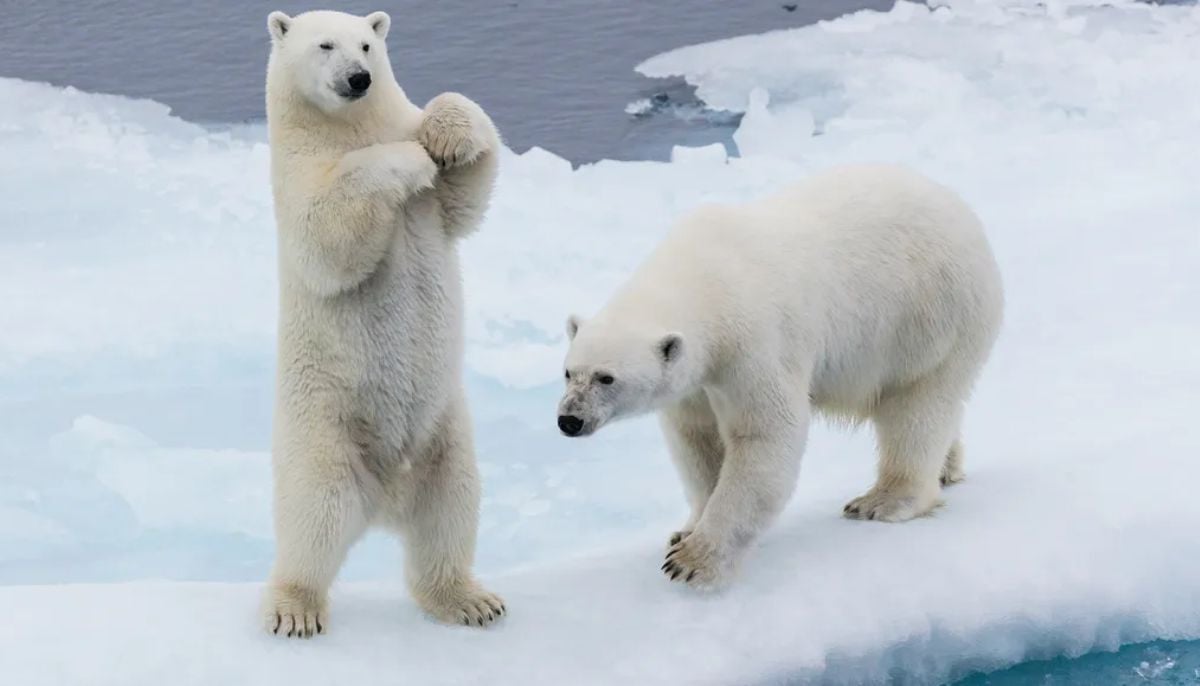
Polar bears need ice for their long-term survival, as reduced or shrinking ice forces these creatures to travel long distances in search of food, at the expense of their body fat reserves.
The rapidly disappearing ice phenomenon therefore puts polar bears at great risk of starvation.
According to the 2020 forecast, polar bears could face local extinction in some parts of the Arctic by 2100 if the world fails to reduce greenhouse gas emissions.
To the researchers’ surprise, polar bear populations around the Norwegian island of Spitsbergen are defying the effects of climate change.
These Svalbard populations are getting heavier and fatter as Arctic sea ice rapidly melts, as reported by the study published in the journal Scientific reports.
The body conditions of polar bears on Spitsbergen have improved despite the fact that the ice has disappeared by 100 in a period of 27 years.
For example, researcher Jon Ars and colleagues have investigated the possible cause of a stable body weight in combination with increased fat reserves.
According to the findings of scientists, Svalbard bears, unlike bears in other regions, successfully hunt on land and prey on reindeer, which have recently experienced population growth.
These animals provide food during the summer, when bears are fasting.
“These polar bears have alternatives that they do not always have in other areas,” says Aars.
Another reason behind their improved body weight could be the easier hunting of seals. Melting ice can push ringed seals into smaller and dense patches of remaining ice, bringing the seals close to bears.
Alice Godden, senior research fellow at the University of East Anglia in England, said: “Whatever the reason, this news is unfortunately not as positive as it sounds. “I think it is a small window of hope. The availability of food will really determine whether they survive or not.”
According to Godden, as with bears in Greenland, a rapid change in DNA could also explain why Svalbard bears are doing well.
Given the increasing threat of climate change, the Arctic ecosystem will eventually pass a tipping point with irreversible changes.
“It will become more difficult to be a polar bear on Spitsbergen in the future,” says Aars.