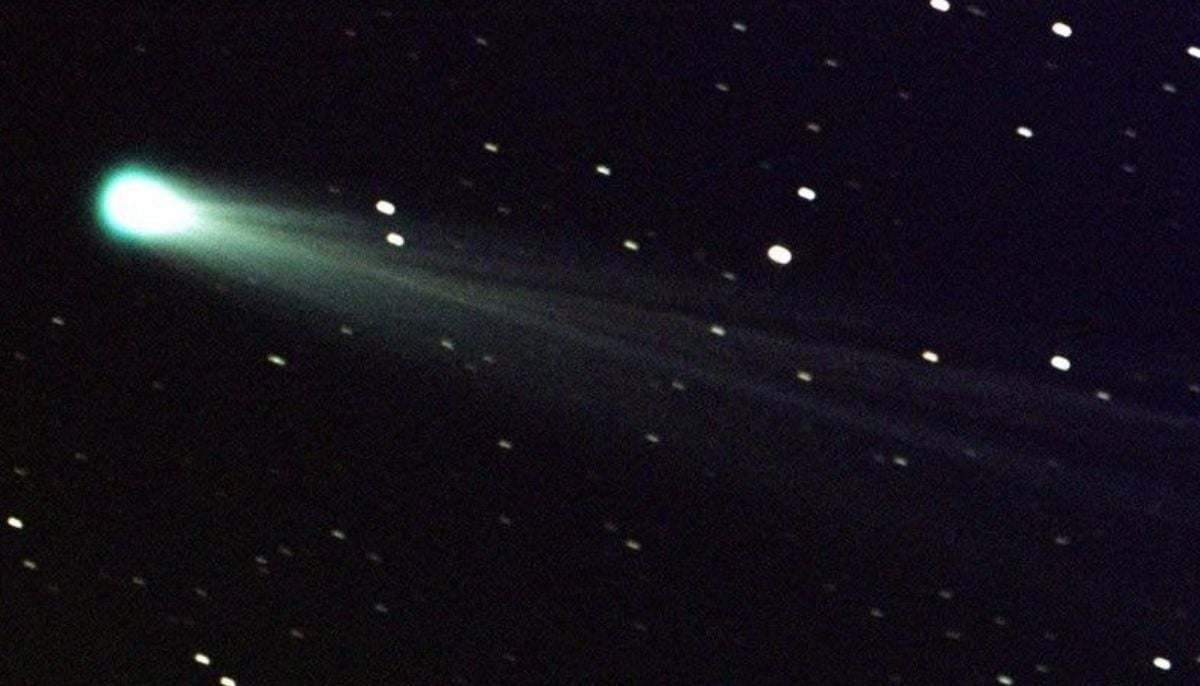
The bright green comet C/2024 E1 (Wierzchoś) shows increasing brightness as it approaches Earth. The comet, which scientists found in March 2024, has received international attention for its exceptional orbit and bright appearance.
Astronomers say C/2024 E1 will leave the solar system on a hyperbolic path that will halt its return as they predict the comet will reach its closest point to Earth next week.
C/2024 E1 (Wierzchoś) comet
Polish astronomer Kacper Wierzchoś discovered the comet at the Mount Lemmon Observatory. The James Webb Space Telescope confirmed high carbon dioxide levels in the comet’s coma, which describes the luminous gas and dust cloud surrounding the frozen core.
Scientists initially estimated the core’s diameter to be 13.7 kilometers, equivalent to the size of a city, but current findings indicate a smaller size. Researchers classify C/2024 E1 (Wierzchoś) as a long-period comet that likely originated in the remote Oort Cloud at the edge of the solar system.
The experts believe that the comet slowly moved toward the inner solar system for between one and three million years, where it landed for the first time. After reaching its closest point to the Sun in January, the comet is now heading towards its closest point to Earth, which will remain visible through telescopes and high-powered binoculars.
Astronomers report that the comet will use its proximity to the Sun as a ‘solar catapult’ mechanism, allowing C/2024 E1 (Wierzchoś) to leave the Solar System and head into deep interstellar space. This unique green comet will travel through the Milky Way galaxy for millions or even billions of years after leaving our planet.