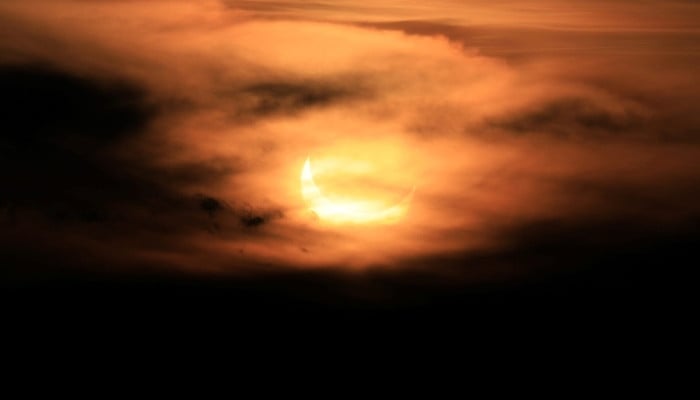
Sky Watchers will be responsible for a treat later this month as a partial solar eclipse will unfold at night on September 21-22, according to the US National Aeronautics and Space Administration (NASA).
The event will not be visible in the United States, but observers in Australia, Antarctica and about the Pacific and Atlantic Oceans will witness it.
However, Pakistan will miss. The Climate Data Processing Center of the Pakistan Meteorological Department (PMD) said that the Eclipse will start on September 21 at 10.30 pm, peak at 12:42 pm and ends at 2:54 am – although it will not be visible from everywhere in the country.
According to Vs todayNASA explains that a partial solar eclipse takes place when the moon glides between the sun and the earth without perfect alignment, leaving a glowing half moon in sight.
This month this month will be the second Big Sky event-the first was a total lunar eclipse on 7-8 September. And there is more: the September equinox follows only a day later, on September 22, when day and night are almost worldwide.
Looking ahead, NASA says that the next total solar eclipse is visible in parts of North America on 12 August 2026, which cross Greenland, Iceland, Spain, Russia, Russia and a small corner of Portugal.
A partial eclipse on that date will be visible in North America, Europe, Africa, the Atlantic, Arctic and Pacific. In addition, there is a ring -shaped solar eclipse on 17 February 2026, visible in parts of Antarctica, with a partial solar eclipse in Africa, South America and various oceans.
NASA has one important memory: never look directly at the sun without the right eclipse glasses or filters. “Viewing a part of the bright sun through a camera lens, binoculars or a telescope without a special sun filter … will immediately cause serious eye injury,” the desk warns.