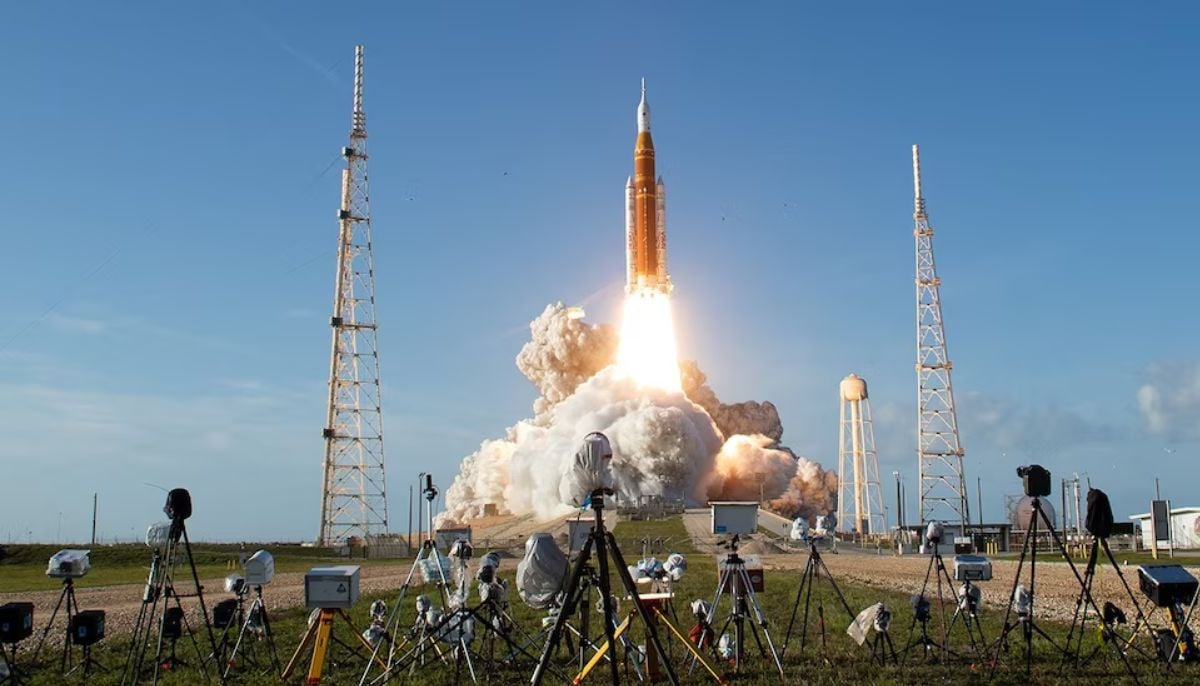
The lunar surface has been a graveyard of footprints and discarded machinery for more than half a century. The silence on the moon began to end with the Artemis program, which started in April 2026. We are no longer just visiting; we are moving.
Astronomer and physicist Shaheer Niazi of the Paris Observatory explains this change: “Fifty years ago, humanity achieved its first moon landing through the Apollo space program. Twelve astronauts walked on the moon’s surface. But then decades passed and the moon remained an untouched frontier.” Today, that frontier is being claimed by a new generation of explorers who see the moon not as a destination but as their permanent home.
He goes on to explain that the Artemis program is designed to break this long hiatus and instead establish continuity.
“Recently, however, that ambition has changed. Today, NASA’s Artemis program marks a return not just to exploration, but to a permanent human settlement on the moon.”
From Apollo to Artemis II
The Artemis program advances its mission through successive missions that reduce operational risk while preparing for the landing of human astronauts on the moon. The Artemis I mission demonstrated the safe lunar orbit and return to Earth capability of the Space Launch System rocket and Orion spacecraft through tests without astronauts.
The series begins with Artemis II, which marks the first human-operated mission. The mission aims to evaluate life support systems and navigation capabilities and astronaut performance during deep space operations.
“Artemis is conducting a series of tests and will eventually land humans on the moon. Currently, Artemis II has orbited the moon, but upcoming missions will soon deploy humans and a space habitat, which will be built on the moon’s south pole,” Niazi added.
More importantly, the South Pole has become a focal point for its resources, supporting sustainable missions, because this side of the moon contains frozen water that supports life and serves as fuel as it receives almost perpetual sunlight, making it suitable for permanent operations under the Artemis Moon Race program.
“They will carry out this mission at the South Pole because of its importance. It is important because it is believed that there are volatile substances there, frozen water and hydrogen, which can serve as fuel for these future habitats,” Niazi points out.
The Artemis Moon Race is no longer limited to one country, with China emerging as a strong competitor.
“However, the United States is not alone in this endeavor. China has also announced its intention to conduct a manned lunar mission by 2030. China has already successfully landed rovers on the far side of the moon, a feat no other country has achieved.”
Moreover, Pakistan has also entered the conversation through recent technological contributions.
“Pakistan also had a major share of recent developments with the iCube-Qamar, developed by the Institute of Space Technology in collaboration with Chinese scientists. A Chinese rocket took this CubeSat, a small satellite, to a small orbit around the moon, and returned some pictures taken of the moon,” he explained.
Modern space exploration faces increasing competitive challenges, but maintains cooperation as an essential development framework. Niazi questioned whether the moon conflict represents a new Cold War, while wondering whether space competition between countries has transformed into a moon race. According to him, both countries officially support peaceful cooperation.
The future development of lunar movements and base construction work will receive its initial guidance from international partnerships currently operational.
Highlighting future developments, Niazi says the space agencies of America, Canada and Japan are working with the Japanese space agency JAXA to develop a lunar vehicle that will serve as the main method of lunar transportation.
The space team will create new applications for existing technology that will allow humans to control equipment beyond Earth.
“So yes, there will be a Toyota on the moon in the near future,” he added.
The Artemis Moon Race plan goes beyond the original goal of marking territory through landings as it aims to achieve permanent human presence on the moon.
The Apollo program started as a fast-paced mission that later developed into a space race, but Artemis has become a long-distance competition for space exploration. According to Niazi, the first human settlement on the moon, together with the operational base, will be at the South Pole by the year 2030, which will develop into a full-scale base by 2040.