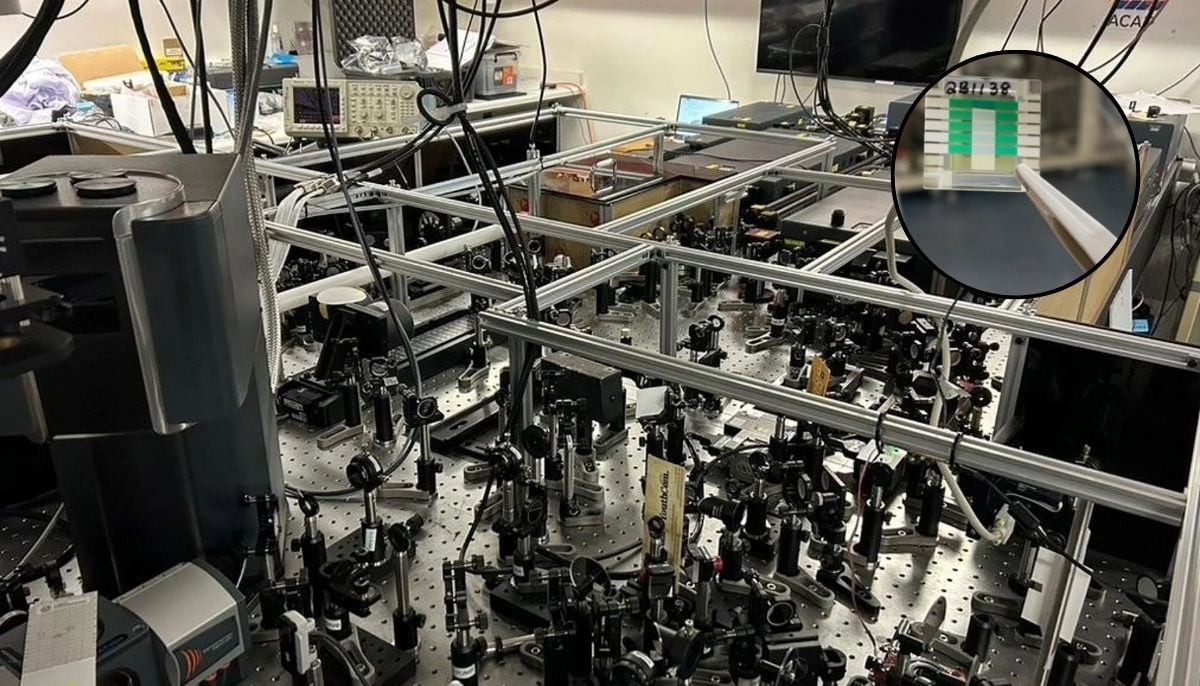
In a major energy breakthrough, Australian scientists have developed the world’s first proof-of-concept quantum battery.
The researchers led by the Commonwealth Scientific and Industrial Research Organization (CSIRO) have developed a next-generation battery prototype that can be charged wirelessly with a laser, marking a significant step towards the future of energy storage.
Quantum batteries often work according to the principles of quantum mechanics to store energy and are more efficient than conventional batteries.
According to lead author and researcher Dr. James Quach from the CSIRO is the first prototype efficient at completing a full cycle of a battery, meaning that once you charge the battery you store energy and can discharge it.
The prototype differs from conventional batteries because traditional batteries take longer to charge.
On the other hand, “quantum batteries have the special property that the larger they are, the less time it takes to charge,” Quach said.
The difference in charging capacity is due to a distinguishing feature known as ‘collective effects’, where quantum cells charge faster as the number of cells increases.
Quach and his team first demonstrated this feature in 2022, but at that time they did not yet come up with a way to extract energy from that prototype.
Characteristics of quantum battery
The new quantum battery prototype documented in the journal Light: science and applications the energy took femtoseconds to charge and stored for nanoseconds.
According to Quach, if charging the battery took one minute, six orders of magnitude would keep the battery charged for a few years.
With a capacity of only a few billion electron volts, the current prototype is not powerful enough to power anything useful.
“What we need to do next is… increase the storage time. You want your battery to stay charged for more than a few nanoseconds if you want to be able to talk to someone on a cell phone.” Quach added.
Professor Andrew White, head of the quantum technology laboratory at the University of Queensland, said: “Quantum batteries could deliver energy coherently… with the minimum energy cost to the quantum computers.”