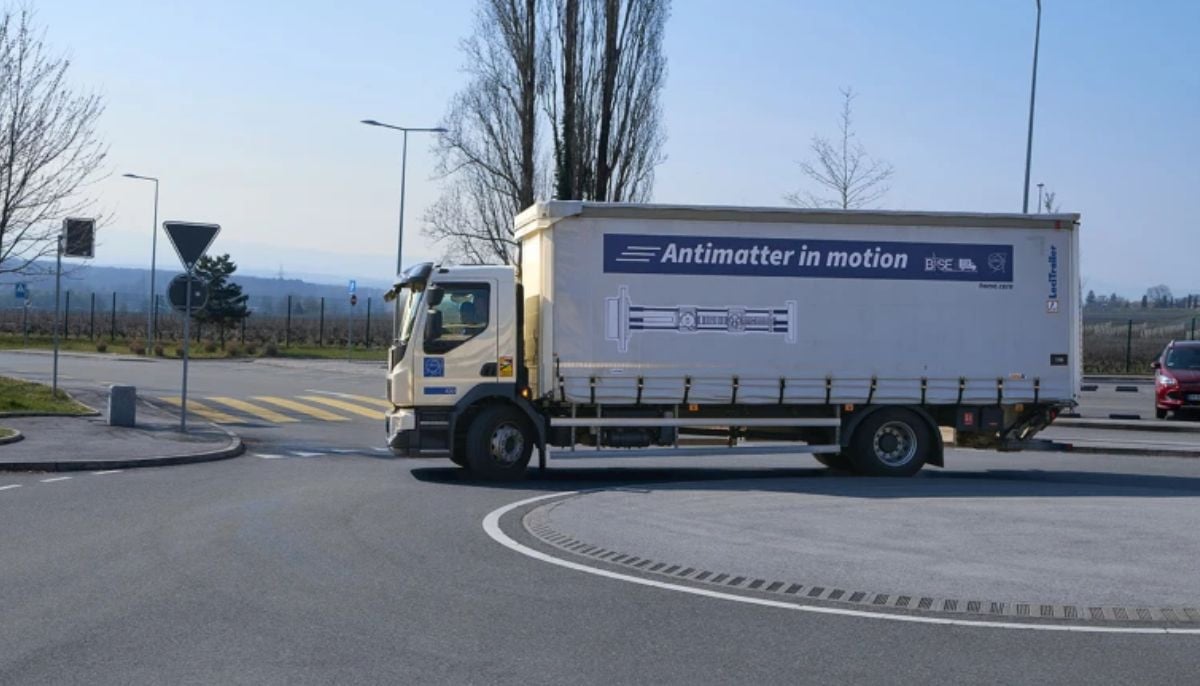
In a groundbreaking milestone for particle physics, CERN scientists successfully transported antiprotons by road this Tuesday, marking the first-ever test of a mobile antimatter delivery system.
The transport of 92 antiprotons took place in a specially designed bottle that captures the particles using magnetic fields. During the 30-minute journey, antiparticles were safely moved to a location free of experimental noise, where they can be closely studied.
They were cooled to -268 degrees Celsius to slow them down, while a strong vacuum system ensures they don’t destroy by colliding with the remaining gas in the trap.
This achievement paves the way for a future where antimatter, which is notoriously difficult to control, can be distributed to research facilities across Europe.
“It is something that humanity has never done before, it is historic and marks the starting point of a new era,” says Stefan Ulmer, a physicist at Heinrich Heine University Düsseldorf (HHU), in Germany, and a member of the team.
Another physicist at the University of Liverpool, Tara Shears, called this achievement a “technological miracle”, as antimatter is considered the most fragile type of matter in the universe. When it comes into contact with normal matter, the antiprotons annihilate and energy is released.
Antimatter is useful in studying other phenomena, including the structure of radioactive nuclei, and in unraveling the undiscovered mysteries of the universe.
The next step of the project, known as BASE-STEP, involves delivering the payload to another CERN site.
“For the BASE collaboration, today is really the starting point for completely new types of experiments,” says Ulmer.
“It is one of the most fundamental mysteries in our subject, and I hope that precise measurements of CERN antimatter samples can give us new clues,” Shears added.