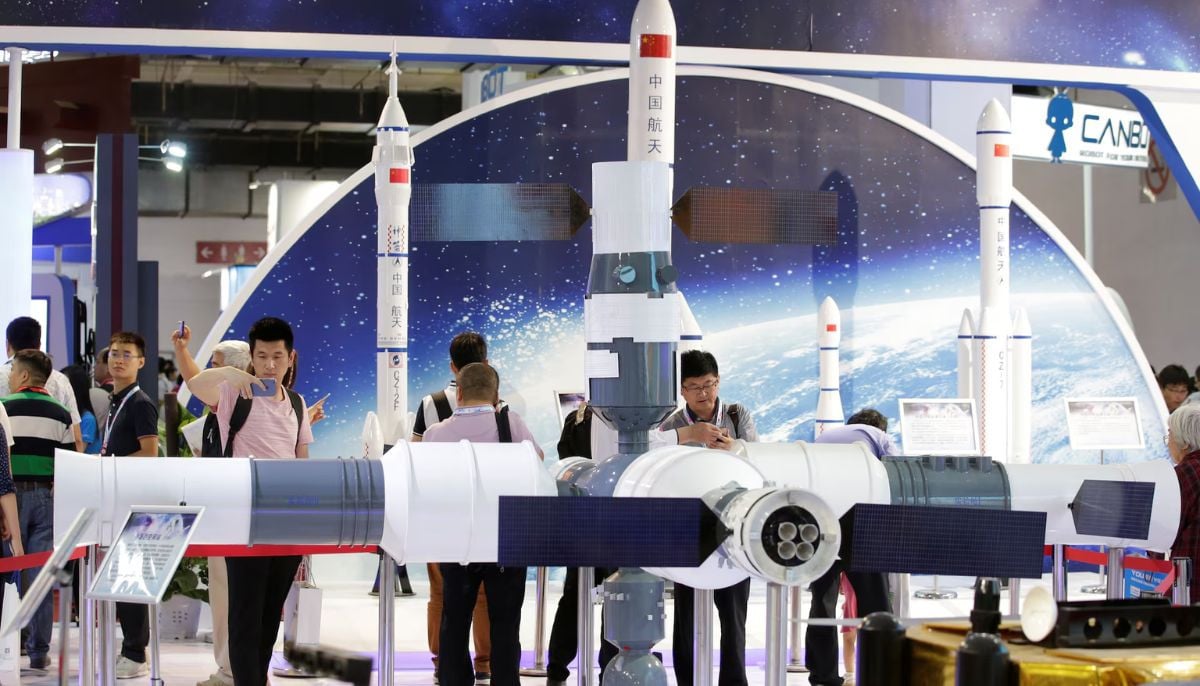
China has officially accelerated its timeline for space tourism development over the next five years, marking a major step towards challenging US dominance in deep space exploration. State-owned China Aerospace of Science and Technology Corporation (CASC) said it is working on operationalizing sub-orbital space tourism and will gradually expand to orbital offerings.
The main motive behind the space race between China and the US is to transform space exploration into a commercially viable industry, similar to civil aviation, while advancing military and strategic goals for space dominance.
CASC aims to transform China into a “world-leading space power” by 2045. According to official announcements, China achieved a record 93 launches in 2025, supported by the rapid growth of its commercial space startups.
China has often described SpaceX’s monopoly on LEO satellites as a national security risk. That’s why the country is working to launch its own satellite constellations, which it hopes will number tens of thousands in the coming decades.
Chinese entities have submitted documents to the International Telecommunications Union (ITU) outlining plans to launch approximately 200,000 satellites into orbit over the next fourteen years. Two-mega constellations account for the vast majority of this figure; a major step aimed at strategically reversing orbital slots and frequencies for Beijing.
In this regard, Xinhua wrote: “The next ten to twenty years will be a period for a leap of faith in the field of Chinese interstellar navigation. Original innovations in basic research and technological breakthroughs will reshape the pattern in deep space exploration.”
According to Reutersthe recent project will signal Chinese ambitions for a structured evolution from low-Earth orbit operations to deep space exploration. It will support China’s planned lunar exploration program and its efforts in detecting exoplanets outside our solar system.
The Chinese lunar probe Chang’e-6 was the first spacecraft to return samples from the far side of the moon in 2024. Beijing is actively involved in shaping international space and space infrastructure standards to become a leading global space power.