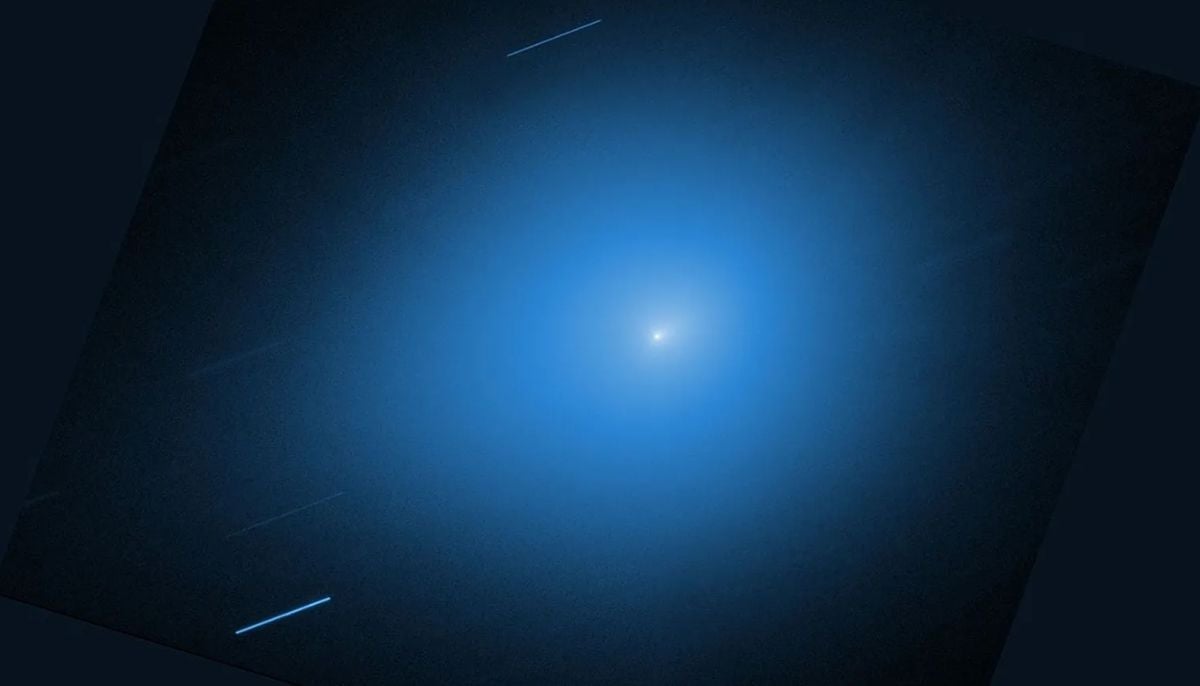
A visitor from another galaxy is creating excitement in the astronomy community. First spotted in July 2025, comet 3I/ATLAS contains chemical clues that scientists can use to study the formation of other planets, the existence of aliens and icy bodies in space.
Using the Atacama Large Millimeter/submillimeter Array (ALMA) in Chile, researchers can discover that the comet emitted extremely large amounts of methanol, a type of alcohol, through its luminous gas halo.
Comet 3I/ATLAS reveals a unique chemical fingerprint
Nathan Roth, principal investigator at the National Radio Astronomy Observatory (NRAO), said: “Observing 3I/ATLAS is like fingerprinting another solar system. The details reveal what it’s made of, and it’s bursting with methanol in a way we don’t normally see with comets in our own solar system.”
ALMA has detected strong signals of methanol (CH3OH) in the comet’s expanding coma, while hydrogen cyanide flows mainly from the nucleus. Methanol is released from the core and from icy grains that behave like miniature comets, the first time such behavior has been mapped in an interstellar object.
The high methanol content indicates that 3I/ATLAS probably formed under colder conditions or had a different chemical composition than our Solar System. Methanol is known to be present in comets and is produced on icy dust grains in interstellar clouds. However, its content is much higher in 3I/ATLAS compared to that found in comets in our solar system.
The comet’s tail and gas jets emit glowing X-rays as solar wind particles hit escaping materials, providing more clues about the comet’s composition and structure.
Discovered by the Asteroid Terrestrial-Impact Last Alert System in July 2025, 3I/ATLAS is the third known extrasolar object, after ‘Oumuamua in 2017 and 2I/Borisov in 2019.
American university professor Nathan Roth said studying the comet is a rare opportunity to see how the building blocks of other planets were made billions of years ago.