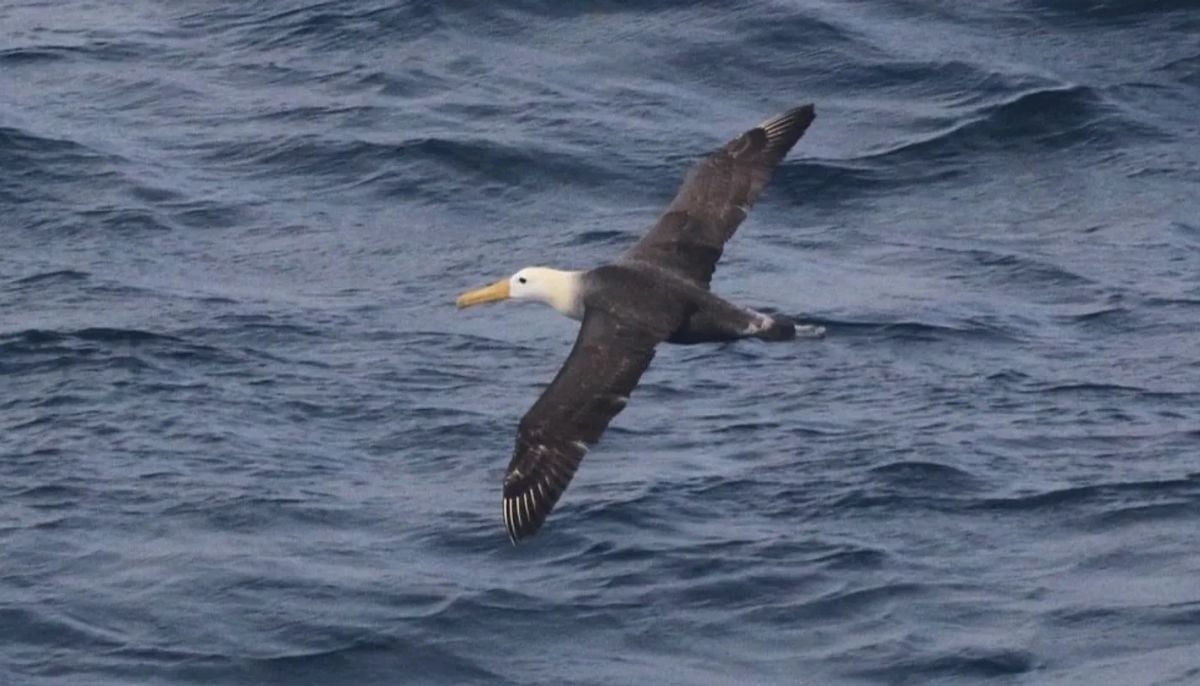
Scientists are currently tracking a Tristan Albatross, a critically endangered species, which has embarked on a groundbreaking expedition from its home on Gough Island in the South Atlantic Ocean. Recently, a research vessel spotted a Waved Albatross off the coast of Central California, marking only the second recorded sighting of this species north of Central America.
The yellow-billed bird with black button eyes, which can have a wingspan of 8 feet (2.4 meters) and spends much of its life in the skies above the ocean, is at the center of a mystery.
Researchers wonder if this ‘wandering’ bird is traveling far beyond its normal range. It was spotted 23 miles offshore from Point Piedras Blancas, about halfway between San Francisco and Los Angeles.
Is climate change leading the Albatross further away from home?
Scientists have revealed that seabirds such as albatrosses travel great distances in search of food. On rare occasions, an individual’s routine can lead them to end up far from home, sometimes even in the wrong hemispheres or exceptionally in the wrong ocean.
Although a factor such as food scarcity may prompt a bird to wander, a single sighting may simply be a fluke.
According to the American Bird Conservancy, the species’ range is limited to the tropics because it nests on lava fields, scattered rocks and sparse vegetation.
One analysis suggests that if multiple birds are spotted in California, it could indicate they are being pushed north by environmental factors.
For example, five species of Booby are now becoming more common in California due to rising warm temperatures and marine heat waves.
Albatross migration: growing conservation concerns
The species is already threatened by invasive mice on Gough Island that eat their chicks alive. The risk factors increase as the population has to travel thousands of extra kilometers in search of food. The ultimate consequence could be a total collapse of the colony, caused by depletion or increased encounters with commercial fishing boats.