Scientists have moved closer to uncovering the universe’s long-standing mystery surrounding the existence of primordial black holes.
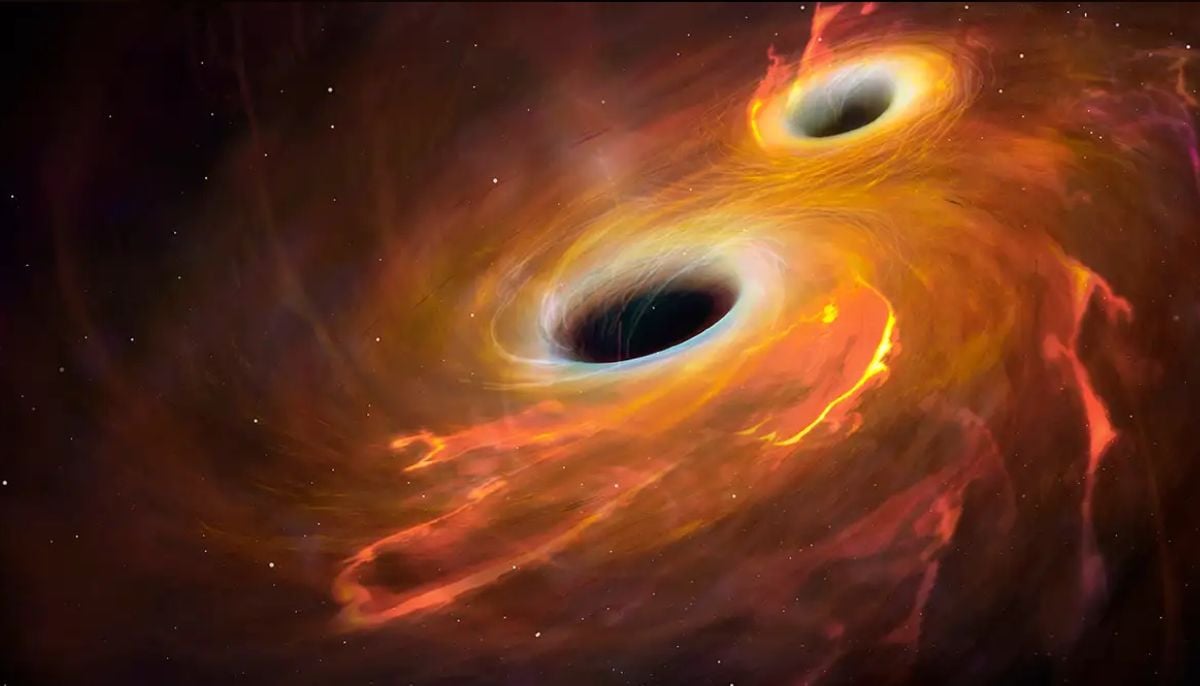
Unlike the well-known black holes created by the explosive collapse of supernovae, primordial black holes are believed to have formed from dense regions of subatomic matter within the first second after the Bing Bang.
For years, primordial black holes have always been theoretical. However, recent lines of evidence have moved these objects from the realm of pure theory to potentially observable entities.
In a recent development, astrophysicists Alberto Magaraggia and Nico Cappelluti, from the University of Miami, have unraveled the mystery of primordial black holes using the Laser Interferometer Gravitational-Wave Observatory (LIGO), spread across two sites in Louisiana and Washington.
LIGO is known for detecting gravitational waves caused by the collision of two black holes.
The researchers found that a signal captured by LIGO, known as S251112cm, indicated a collision between two objects where one of the objects had less than a single solar mass, possibly a primordial black hole.
Primordial black holes are expected to have much lower masses.
“The most common black holes form as a result of a supernova, the death of a massive star. So their masses can range from a few times the mass of the Sun to billions of solar masses.” Cappelluti said.
“We believe our research will help confirm this [PBHs] actually exist,” he added.
Furthermore, an in-depth study of the signal is needed to fully detail the existence of a subsolar-mass PBH.
A groundbreaking study published in early 2026 and conducted by Elio Quiroga explores the detection of “PBH-H protoatoms,” exotic systems in which a primordial black hole acts as a nucleus, capturing a proton and an electron.
Researchers suggest that the James Webb Space Telescope (JWST) could identify these by their unique spectroscopic features in the far infrared range.