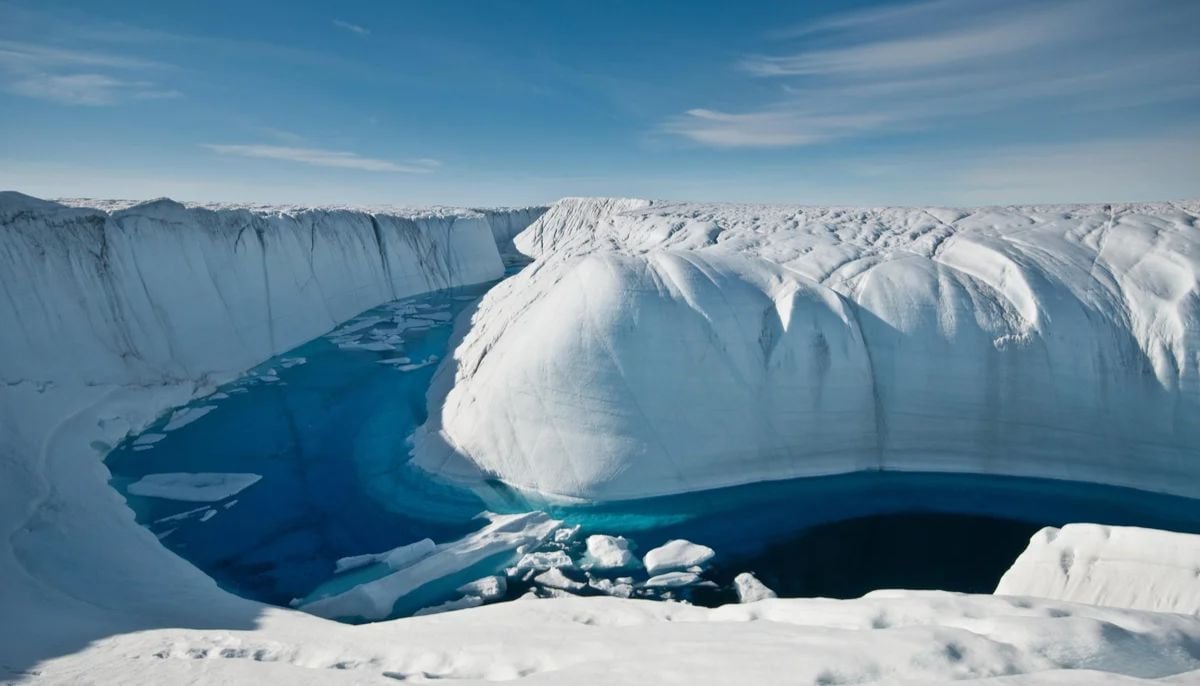
Scientists have discovered the true nature of enormous, upward-warping plumes deep within the Greenland ice sheet in a recent discovery.
For more than a decade, researchers have puzzled the mysterious nature and origin of plumes.
New research suggests these aren’t just random distortions. In fact, they are caused by thermal convection, which reflects the same process that moves molten rock within the Earth’s mantle.
This heat warms the bottom of the ice, making it soft enough to rise in columns (convection), even though the ice remains solid.
According to glaciologist Robert Law of the University of Bergen in Norway, “The discovery that thermal convection can occur within an ice sheet is somewhat counter to our intuition and expectations. However, ice is at least a million times softer than the Earth’s mantle, so the physics just makes sense.”
“It’s like an exciting twist of nature,” Law added.
According to findings published in The cryosphere, the energy powering this motion comes from the Earth’s natural geothermal heat, caused by the radioactive decay and residual heat of the planet’s formation.
In 2014, scientists found these enigmatic structures buried deep in Greenland’s northern ice sheet. They have been trying to solve the puzzle ever since.
“We typically think of ice as a solid material, so the discovery that parts of the Greenland ice sheet actually undergo thermal convection, which is like a boiling pot of pasta, is as wild as it is fascinating,” says climatologist Andreas Born from the University of Bergen.
The discovery will help researchers better understand hidden internal processes and predict how Greenland will contribute to rising sea levels in the future.