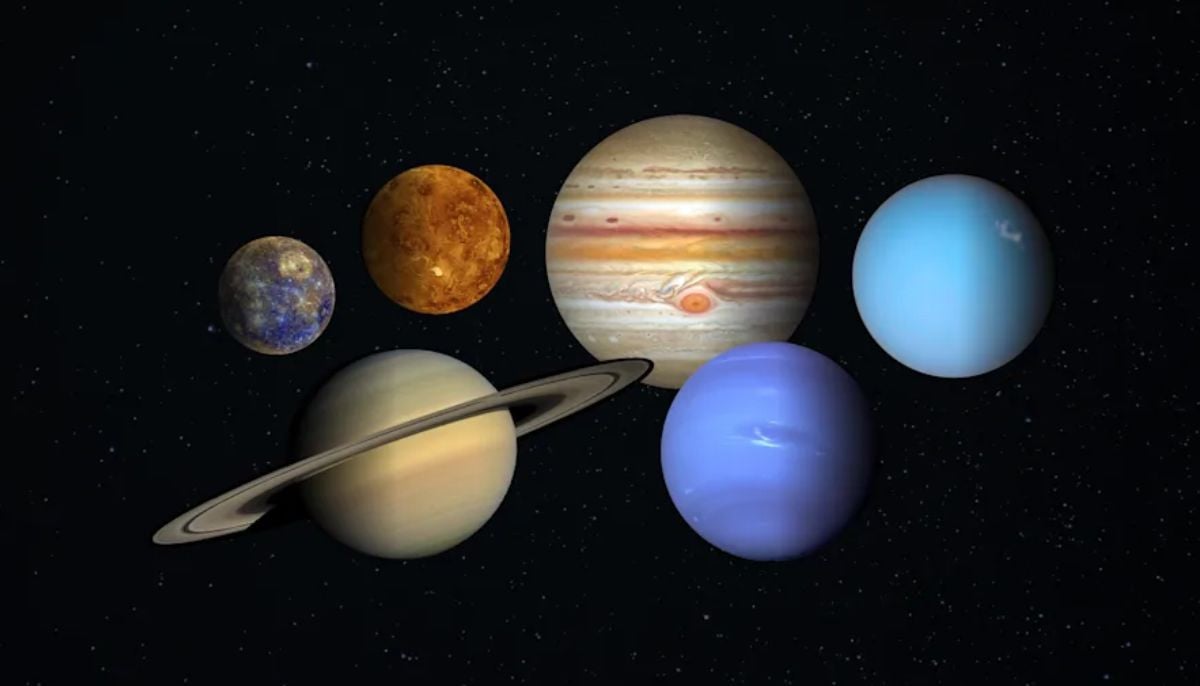
A rare planet parade with six planets currently graces the evening sky. The peak alignment will take place on February 28, and the display will remain visible for several days until early March. Often called a planetary parade, this intriguing phenomenon is not a cosmic spectacle as the name suggests. Astronomers say such alignments aren’t rare, but they do offer something compelling: a chance to see nearly half the solar system at once.
What is a planetary parade?
A planetary parade occurs when multiple planets are visible in the sky at the same time. Depending on the configuration, this could mean four, five or even six planets appearing above the horizon at the same time. A planetary parade is not like a straight line of brighter dots; instead, the planets spread from horizon to horizon. Skygazers can see some planets that may shine brightly, such as Venus or Jupiter, while others, such as Neptune, are only visible through binoculars or a telescope.
When and how can you see the planetary parade?
Although February 28 is the highlight, it is the only day when the planetary parade can be seen. All six planets, namely Mercury, Venus, Jupiter, Saturn, Neptune and Uranus, have been visible in the night sky for a few days. They appear together in a small window just after sunset. Venus, Mercury and Neptune are close to the horizon and set an hour or two after the sun. Jupiter and Uranus are higher in the night sky and remain visible after the other planets descend to the west. Notably, these planetary alignments do not cause dangerous consequences and do not significantly change our planet’s gravity; their combined gravitational influence is negligible compared to that of the moon and sun.