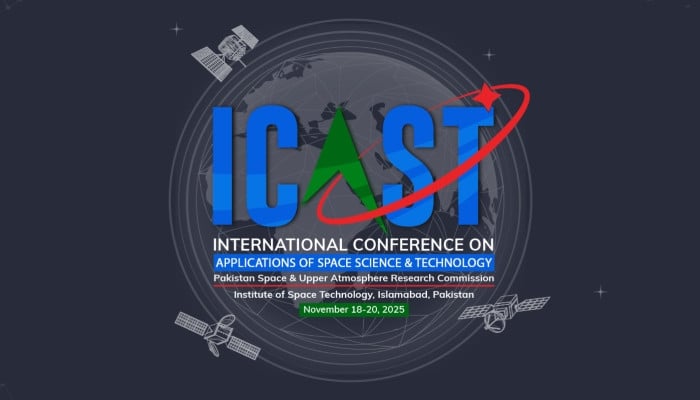
ISLAMABAD: Pakistan on Tuesday took a major step forward in its space program with the launch of the International Conference on Applications of Space Science and Technology (ICAST-2025), billed as the largest forum for space science and technology in the region.
The conference was inaugurated at the Institute of Space Technology (IST) and is jointly organized by the Pakistan Space and Upper Atmosphere Research Commission (Suparco) and IST.
The conference is held in collaboration with the Inter-Islamic Network on Space Sciences and Technology (ISNET), the Asia-Pacific Space Cooperation Organization (APSCO), the Islamic World Educational, Scientific and Cultural Organization (ICESCO), the Institute of Electrical and Electronics Engineers (IEEE) and the National Center of GIS and Space Applications (NCGSA).
The conference brings together astronauts, scientists, policymakers, academic leaders, industry experts and representatives from major international organizations, highlighting Pakistan’s growing leadership in the advancement of space science, technology and innovation at both regional and global levels.
Suparco Chairman Muhammad Yousaf Khan formally inaugurated the conference.
He was proud to host the largest space event in the region and highlighted Suparco’s efforts to strengthen international cooperation and promote space technologies for sustainable development.
IST Vice Chancellor Dr. Syed Najib Ahmad reaffirmed Pakistan’s commitment to promoting space education, research and capacity building, describing ICAST-2025 as an important link between global expertise and scientific advancement.
The Acting Chairman of the Higher Education Commission (HEC), the Secretary General of APSCO and the Director of the United Nations Office for Outer Space Affairs (UNOOSA) also addressed the meeting.
They praised Pakistan’s contributions to promoting equitable access to space science and supporting emerging space nations.
The chief guest, Mongolian astronaut Gurragchaa Jugder Demid, formally opened the conference with a convincing keynote speech.
Recalling the experience of viewing the Earth from space, he stated that science transcends borders and that international cooperation is essential for human progress.
He emphasized the crucial role of space technologies in sustainable development, climate monitoring, disaster preparedness, agriculture, resource management and communications.
He said platforms such as ICAST-2025 ensure that the benefits of space development reach all countries equally. Appreciating Pakistan’s vision, he commended the efforts of Suparco and IST and expressed confidence that the dialogue during ICAST-2025 would lead to new partnerships and innovative solutions.
The first day started with the ISNET Strategic Leadership Summit (SLS), in line with the United Nations Office for Outer Space Affairs’ Access to Space for All initiative. Leaders from OIC-COMSTECH, APSCO, ICESCO and the Turkish Space Agency delivered keynote speeches, followed by a high-level dialogue with representatives from China, Tunisia, Iran, Bangladesh and Senegal.
The summit concluded with the adoption of a joint communiqué, reiterating commitments to equitable access to space, open data sharing, capacity building and closer cooperation among emerging space-faring nations.
The technical program of the conference opened with various seminars, master classes, panel discussions and workshops.
It started with a seminar on space technologies for national security and strategic applications, followed by technical sessions on astronomy and astrophysics, positioning, navigation and timing, remote sensing and geographic information science, and information and communications technologies.
These sessions will include discussions on advances in satellite systems, geospatial analytics, artificial intelligence (AI), and next-generation communications technologies.
The technical program also included a panel discussion on “Precision, Positioning, and Beyond: Emerging Trends in GNSS Technology,” a technology exhibition forum, and special master classes on Physiology in Orbit, Space Law in Action, and Designing Complex Space Missions.
Additional sessions on aviation, satellite technology and environmental sciences expanded the scope of the technical dialogue.
With participation from more than 25 countries and more than 70 international delegates, ICAST-2025 organizes a major global collection of expertise across eight different tracks, including plenary sessions, master classes, special seminars, technical presentations, poster exhibitions and technology shows.
The conference reflects Pakistan’s determination to use space technologies for social development, economic stability, climate resilience, disaster preparedness, scientific advancement and international cooperation.
The conference will continue over the next two days, with the aim of fostering stronger partnerships, broadening global dialogue and advancing the peaceful uses of space for the benefit of humanity.