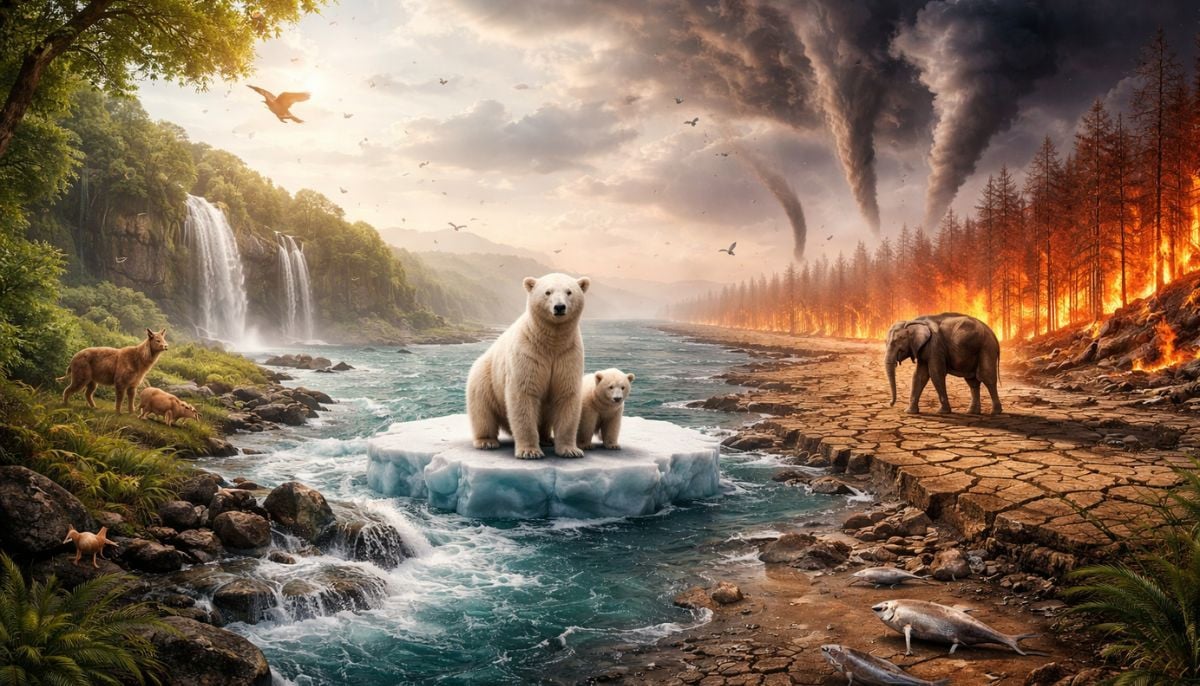
Climate change is one of the harsh realities of the 21st century. The earth is warming rapidly; climate-related disasters are becoming increasingly common; Extreme weather patterns threaten lives, livelihoods and food and water security.
According to the World Meteorological Organization (WMO), 2025 was one of the three warmest years on record, continuing the streak of exceptionally sweltering temperatures on Earth.
When the planet warms to unprecedented levels, the Earth’s inhabitants, including the biodiversity of fauna and flora, bear the brunt of global warming.
Conventional ecological theory suggests that the severity of climate change should accelerate ecological “rearrangement” as species migrate to survive and new species colonize their habitats.
Rising temperatures and changing climate zones also accelerate “species turnover,” a change in composition in a given area over time and space.
Conventionally, the turnover rate should be high, given the intensity and frequency of the climate crisis. But nature has defied and fallen short in terms of realignment.
A study conducted by Queen Mary University of London (QMUL), published in Nature communication, highlights this unusual phenomenon.
An analysis of a century of global biodiversity data shows that the turnover rate has fallen by about a third since the 1970s.
Professor Axel Rossberg, co-author from Queen Mary University of London, said: “We were surprised at how strong the effect is. Sales figures typically fell by a third.”
Researchers attribute this event to a ‘stalling’ event, with nature slowing down as climate change increases.
Dr. Emmanuel Nwankwo, the lead author of the study, said: “Nature functions like a self-healing engine, constantly replacing old parts with new ones. But we found that this engine is now grinding to a halt.”
Global warming is not the only culprit
According to the findings, rising temperatures alone are not the driving force behind the ‘revenue paradox’. In fact, ‘multiple attractors’ are at play to bring about this shift.
Ecosystems are not just victims of the climate. There are internal biological interactions, which drive species to change places and challenge the dominance of individual species.
The recent research also validated the theory of multiple attractive factors predicted by theoretical physicist Guy Bunin in 2017.
The current delay shows that the internal engine is breaking down.
Human impact
According to researchers’ observations, the loss of regional biodiversity also slows turnover. For an ecosystem to replace an ‘old part’ with a ‘new part’, a nearby population of different species must be ready to move in.
Unfortunately, human-induced habitat destruction has depleted these regional pools.
With fewer ‘colonizers’ available, the replacement cycle fails.
Dr. Nwankwo said: “In other research we see clear evidence that human influences are slowing down sales. It is worrying.”