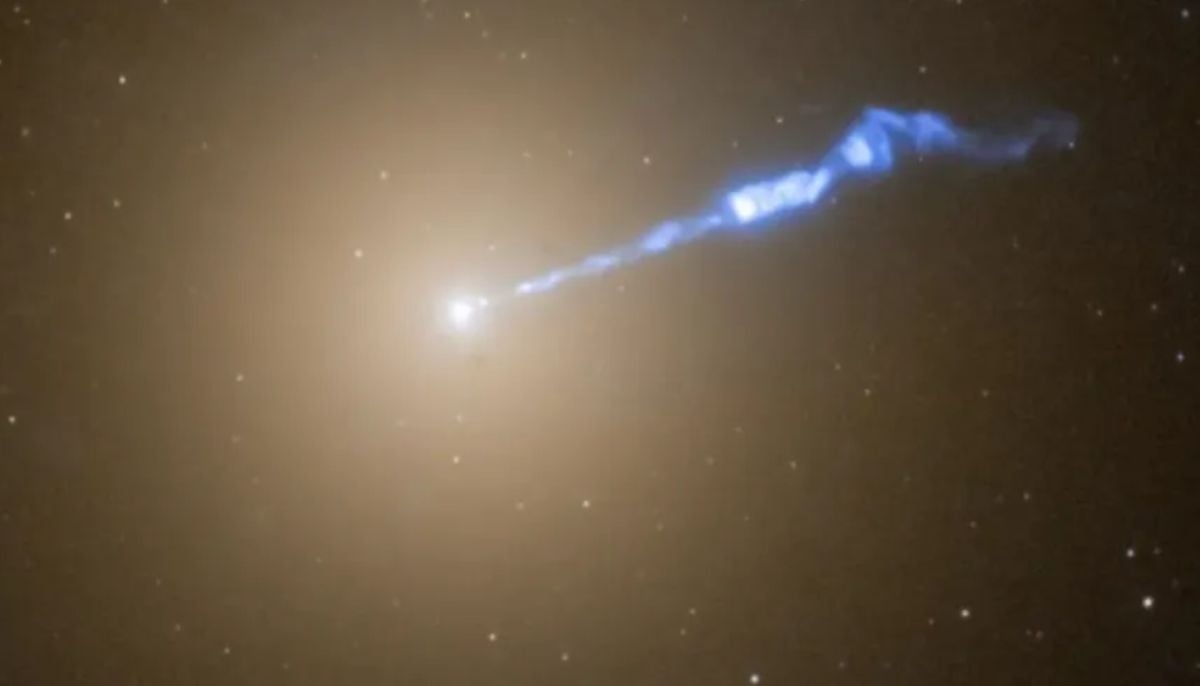
Astronomers have identified the origin of the massive jet of plasma emerging from the supermassive black hole at the heart of galaxy M87. Using updated data from the Event Horizon Telescope, scientists have now directly connected the black hole’s shadow to the base of a jet that extends nearly 3,000 light-years into space.
Located 55 million light-years from Earth, M87 made history in 2019 as the first black hole to be photographed. Interestingly enough, the black hole weighs 6.5 billion suns.
For a long time, scientists could see the bright ring and the distant jet of the black hole, but the connection between the two was unclear.
How scientists linked jet and black hole?
New research using Event Horizon Telescope data acquired in 2021 has filled in the gaps to complete the picture. The dataset also includes medium-baseline data, allowing researchers to observe both the compact ring and the jet structure simultaneously.
Additional radio emission has also been detected, in addition to what the ring structure formed by the black hole emits. The additional emission comes from a compact object located just 0.09 light-years from the black hole, at one end of the jet structure.
Lead researcher Saurabh said identifying the jet’s origin provides important information about the long-distance flow of energy in black holes. The images taken by the Hubble Space Telescope indicate that the radius of the M87 galaxy extends as far as 3,000 light-years from the center of the galaxy.