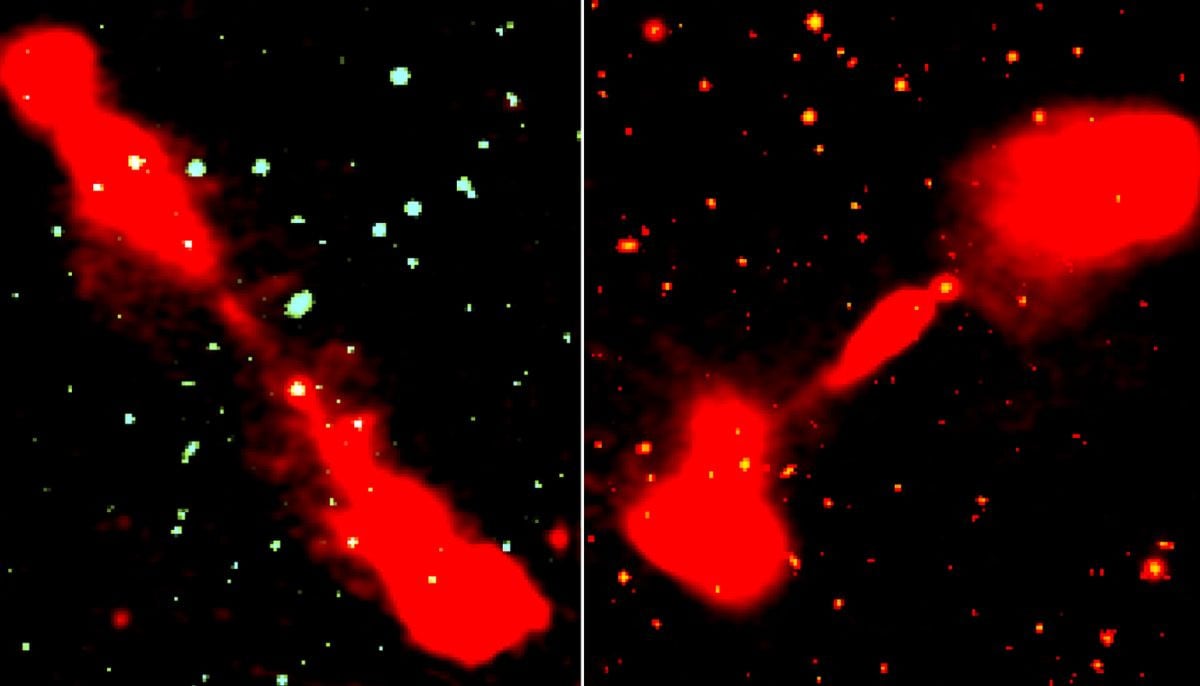
In a groundbreaking discovery, astronomers have successfully discovered 53 new quasars powered by supermassive black holes that spew out jets of matter at relativistic speeds. These jets extend as far as 7.2 million light-years, making them 20 to 50 times wider than the width of the Milky Way.
These monster objects, mainly Giant Radio Quasars, were recently revealed by Indian astronomers as part of a collection of 369 radio quasars.
For that purpose, the data was collected by the Giant Meterwave Radio Telescope (GMRT), an array of 30 parabolic dishes near Pune, India, as part of the TIFR GMRT Sky Survey (TGSS).
The TGSS was observed to cover about 90% of the celestial sphere above Earth.
The phenomenon of the supermassive black hole
To power a quasar’s immense energy, a supermassive black hole must be surrounded by a dense supply of gas and dust on which it can feed.
This matter spirals around supermassive black holes in oblate cloud structures called accretion disks. These powerful tidal forces generated in this spiral matter ultimately resulted in brightly emitted radiation across the entire electromagnetic spectrum.
In this regard, team leader Sabyasachi Pal, an astronomer at Midnapore City College, said: “Their enormous radio jets make these quasars valuable for understanding both the late stages of their evolution and the intergalactic medium in which they expand; the clumpy gas that traps their radio lobes millions of light-years from the central black hole.”
The research team examined Giant Radio Quasars and their environments. They found that about at least 14% of these are colossal objects located in groupings and clusters of galaxies that are near intergalactic medium filaments of gas, dust and dark matter.
The environment plays a crucial role in shaping the way these radio jets evolve. In denser areas the jets can be agitated or slowed down by the surrounding gas; conversely, in less dense areas such as the intergalactic medium they can grow freely.
Scientists have shown that although most quasars have two jets, these jets are unequal in length or brightness, a difference called radio jet asymmetry.
However, the asymmetry tells us specifically that these jets are struggling with an uneven cosmic environment.
Nevertheless, the study results help determine that giant quasars at greater cosmological distances appear to be more powerful than those closer to the Milky Way.
Furthermore, this could have happened as the quasars moved away, and the early cosmos appears to have been more turbulent with denser gas distorting the path of these jets.