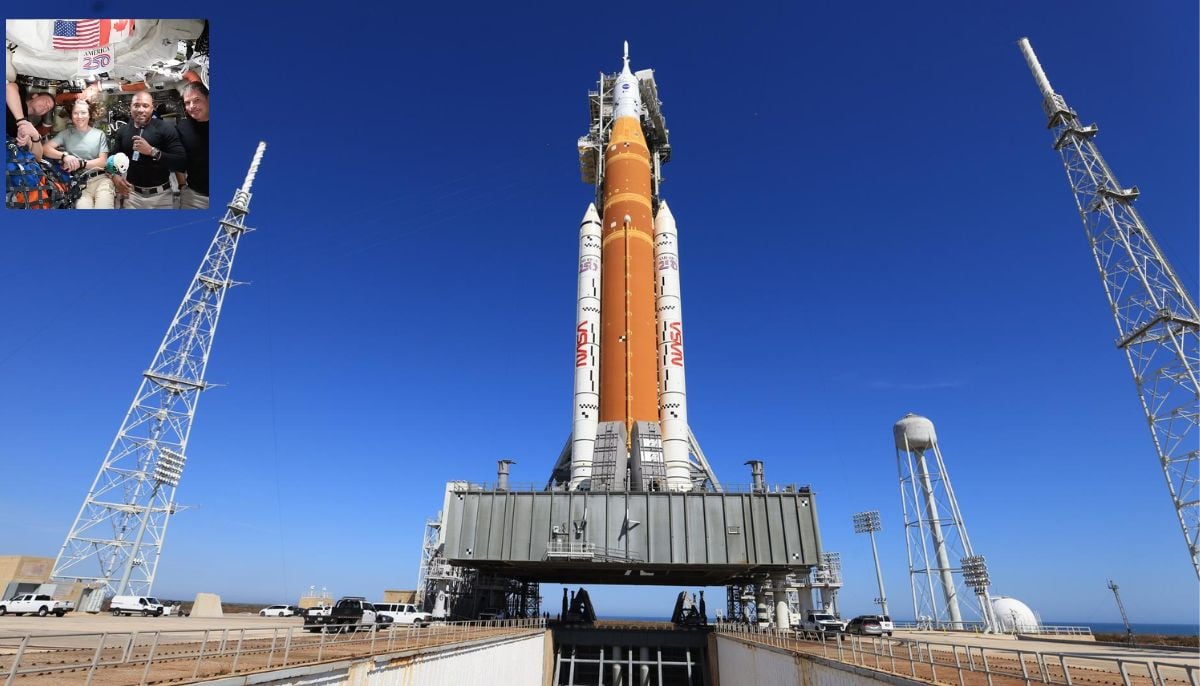
The NASA Artemis II lunar flight mission not only achieved a record distance to Earth, but also paved the way for the 2028 Artemis IV landing.
After reaching this milestone, Artemis II astronauts will reach Earth via a splashdown in the Pacific Ocean.
NASA is using this historic journey as a laboratory to collect data essential for future long-term missions to the moon and Mars.
Using biological samples, wearable technology and organ-on-a-chip sensors, scientists aim to understand the physiological and psychological toll of space environments compared to low Earth orbit.
During the mission, the crew was exposed to high levels of deep space radiation and “galactic cosmic rays” from supernovae, as the Orion capsule, unlike the International Space Station, was not protected by Earth’s magnetosphere.
For NASA, studying the possible consequences is of great importance, as the space agency plans to land on the moon and develop a lunar base.
NASA is investigating how this radiation affects the central nervous system, blood circulation and the potential for long-term problems such as Parkinson’s disease and cancer.
The researchers compare blood samples before and after the flight and collect saliva throughout the journey. Astronauts’ health is monitored in real time via smartwatches.
State-of-the-art computer chips also monitor physiological functions, especially bone marrow, to see how radiation affects blood cell production.
One cannot rule out the possibility of mental health issues that these astronauts may face while living in cramped compartments in pure isolation.
According to Steven Platts, chief scientist of the NASA Human Research Program, the research will help the team understand the variation between low Earth orbit and deep space.
“It will be good research information for us to see the level of radiation, but also the type of radiation,” Platts said.
“Our prediction is that we will see a lot more galactic cosmic rays… which come from supernovae and are everywhere, versus radiation coming from the Sun,” he added.