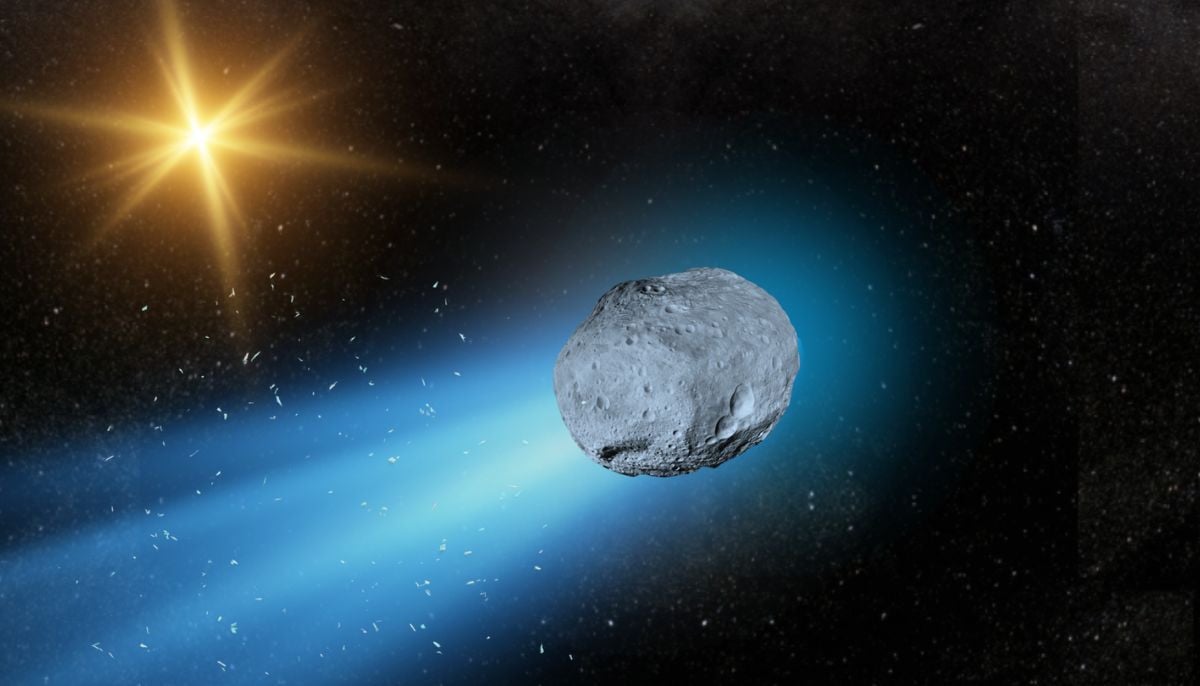
An intriguing new study of the interstellar visitor 3I/ATLAS has revealed that the object’s chemical composition changed significantly during its recent passage through our solar system, offering a rare glimpse into another galaxy.
Using the Subaru Telescope on Maunakea, a team led by researcher Yoshiharu Shinnaka observed the comet on January 7, 2026.
By analyzing the comet’s coma – the gas cloud surrounding the nucleus – the team discovered a surprising shift in the ratio of carbon dioxide to water.
The ratio changed significantly after the comet’s perihelion on October 29, 2025. This suggests that as the Sun’s radiation penetrated deeper into the comet, it began to sublimate several layers of the object.
“By applying the observational and analytical techniques we have developed through studies of solar system comets to interstellar objects, we can now directly compare comets from both inside and outside the solar system and explore differences in their composition and evolution,” team leader Yoshiharu Shinnaka of the Koyama Space Science Institute in Japan said in a statement.
The findings imply that 3I/ATLAS is not a uniform “dirty snowball,” but rather an object with a chemically diverse internal structure. Meanwhile, the team’s data shows that the chemistry on the comet’s surface is different from the ancient materials hidden deep within its nucleus.
While 3I/ATLAS is not only the third interstellar object ever detected, its chemical signatures act as a time capsule of a distant, unknown stellar system.
In this regard, Shinnaka said: “Through studies of such objects, we hope to gain a deeper understanding of how planetesimals and planets are formed in a wide variety of galaxies.”
“With the large-scale deployment of survey telescopes in the coming years, many more interstellar objects are expected to be discovered,” Shinnaka said.
“By examining such objects, we hope to gain a deeper understanding of how planetesimals and planets are formed in a wide variety of galaxies, including our own Solar System.”
As new, powerful survey telescopes come into use, astronomers expect a wave of discoveries of interstellar objects that will further decode the building blocks of the Milky Way.