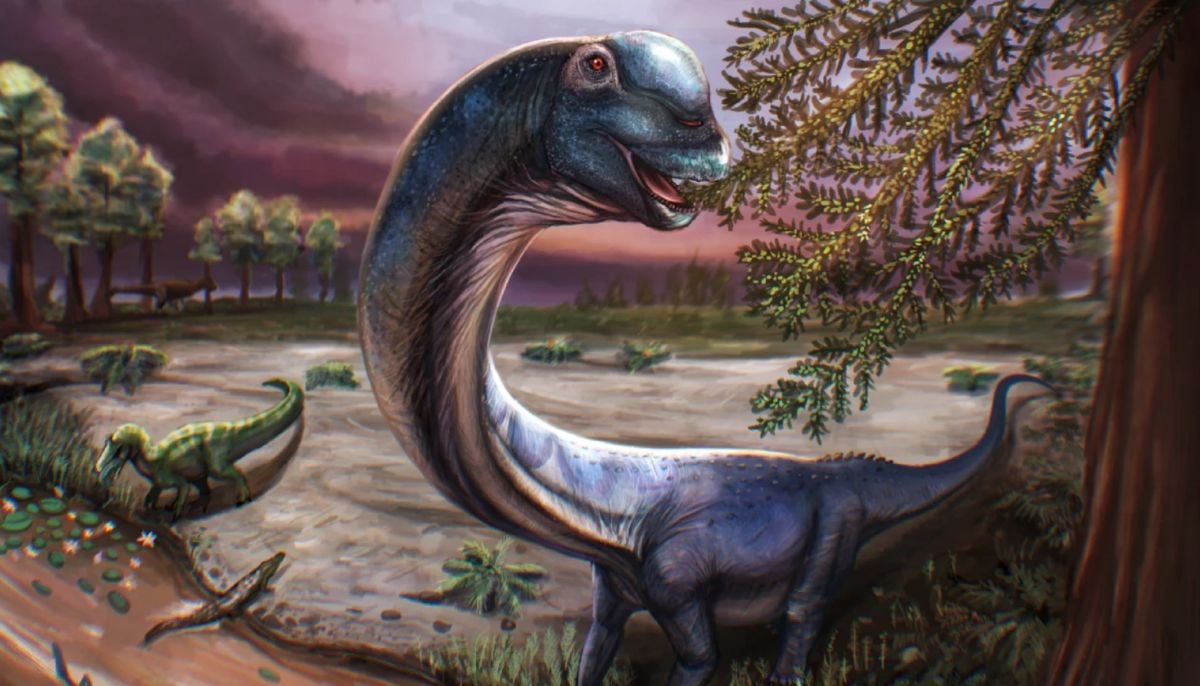
Scientists from Britain and Thailand have identified a new species of giant long-neck dinosaur from remains unearthed in northeastern Thailand. Named Nagatitan chaiyaphumensisIt is officially the largest dinosaur ever discovered in Southeast Asia.
The Naga titan belongs to the sauropod family of long-necked herbivores. It weighed an estimated 27 tons, equivalent to nine adult Asian elephants, and was 27 meters long, making it longer and roughly heavier than a Diplodocus.
It lived during the early Cretaceous period, about 100 to 120 million years ago. Lead author Thitiwoot Sethapanichsakul, a Thai PhD candidate at the University of College London (UCL), called it “the last titan” because its fossils were preserved in Thailand’s youngest dinosaur-bearing rock formation, just before the region turned into a shallow sea.
The creature’s name honors its origins and folklore: ‘Naga’ refers to the mythical serpent from Southeast Asian history, ‘titan’ nods to the giant gods of Greek mythology, and ‘chaiyanphumensismeans ‘from Chaiyaphum’, the specific province where the bones were found near a pond ten years ago.
The Naga titan is the 14th dinosaur species officially named in Thailand.
Thitiwoot Sethapanichsakul, a Thai PhD candidate at University College London (UCL), was the lead author of the study published in the Scientific Reports Journal.
“It is unlikely that younger rocks formed near the end of the dinosaur era contained dinosaur remains because the region had become a shallow sea by then.
So this could be the last or most recent large sauropod we will find in Southeast Asia,” he said.
According to paleontologist Dr. Sita Manitkoon, the country has a great diversity of fossils, possibly ranking as the third most abundant region in Asia in terms of dinosaur remains. The Nagatitan roamed the Earth during a period of intense global warming, marked by a significant increase in carbon dioxide levels in the atmosphere.
Prof. Paul Upchurch of UCL noted that although the sauropod family grew enormously during this period, this extreme size is evolutionarily ‘strange’ because large-bodied animals naturally retain heat and find it incredibly difficult to cool down in warm climates.
Moreover, he told Reuters that it was ‘likely that the high temperatures had an impact on the plant food that was important for sauropods, which were very large-bodied herbivores.’