Neptune’s mysterious and distant moon Nereid could be the sole survivor of a violent cosmic collision that destroyed the planet’s original satellite system.
The new study led by Caltech planetary scientist Matthew Belyakov proposed a new and transformative theory of origins for Neptune’s third-largest moon Nereid.
The findings published in Science Advances were based on data from the James Webb Space Telescope. According to the data, Nereid is not a captured Kuiper Belt object; but it is the only survivor of the original satellite system that was destroyed 4 billion years ago.
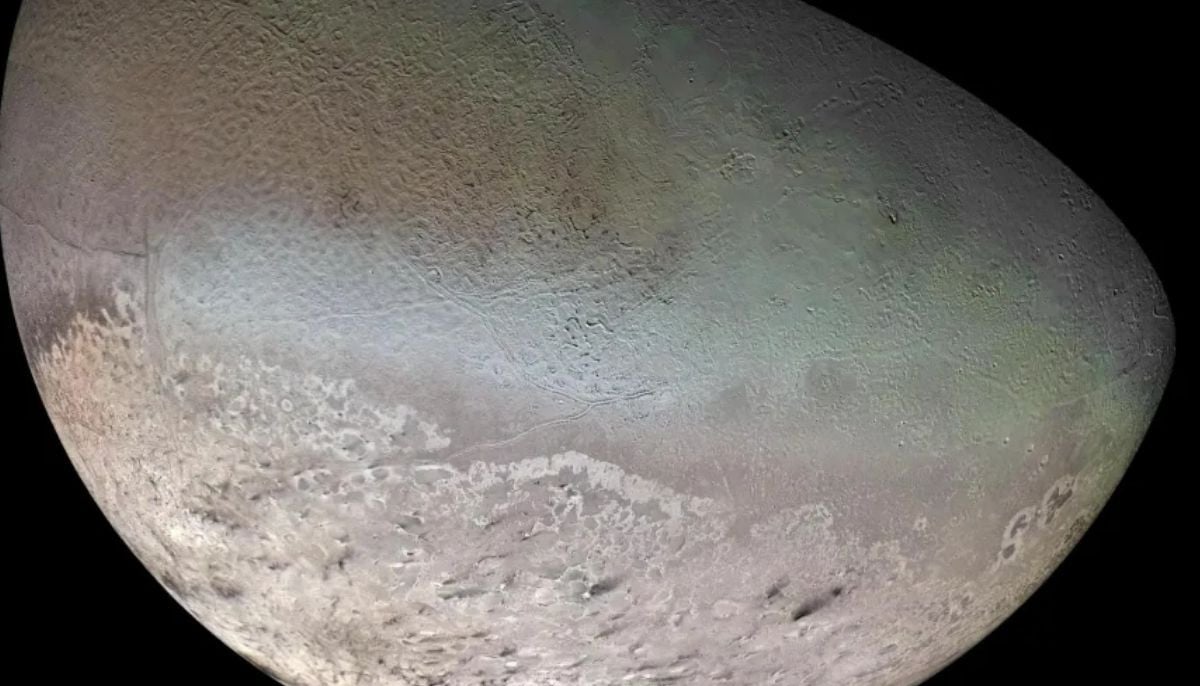
According to astronomers’ observations, the once stable planet Neptune became unstable when its largest moon Triton migrated from the outer solar system and entered Neptune’s orbit. The arrival of Triton caused orbital chaos and massive collisions.
But Nereid survived as the only remnant of that original group.
According to study author Matthew Belyakov of Caltech, “What we know about Nereid is very limited. Due to its size, Nereid has been extremely understudied.”
“I think Nereid is the only intact survivor of this process. The other survivors are Neptune’s innermost moons, but they are not intact because we have images of them from Voyager, and they look like disturbed rubble piles. So they are leftover material from the original system, but not fully intact moons,” he added.
JWST infrared observations revealed that Nereid’s surface is very water-rich and contains CO2, with a signature that reflects the ‘normal’ moons of Uranus rather than the objects typically found in the Kuiper Belt.
Computer simulations show that when a body like Triton enters such a system, there is a roughly 25 percent chance that one or more of the original moons could be pushed into a distant, eccentric orbit rather than destroyed. Investigators believe Nereid is that survivor.
Due to Nereid’s distance and weakness, visual confirmation is limited to a single, blurry 1989 photo from Voyager 2.
Although the JWST data provide strong evidence for a reclassification of the moon’s origins, scientists note that a dedicated future mission to Neptune would be needed to fully understand the history of this unique satellite.