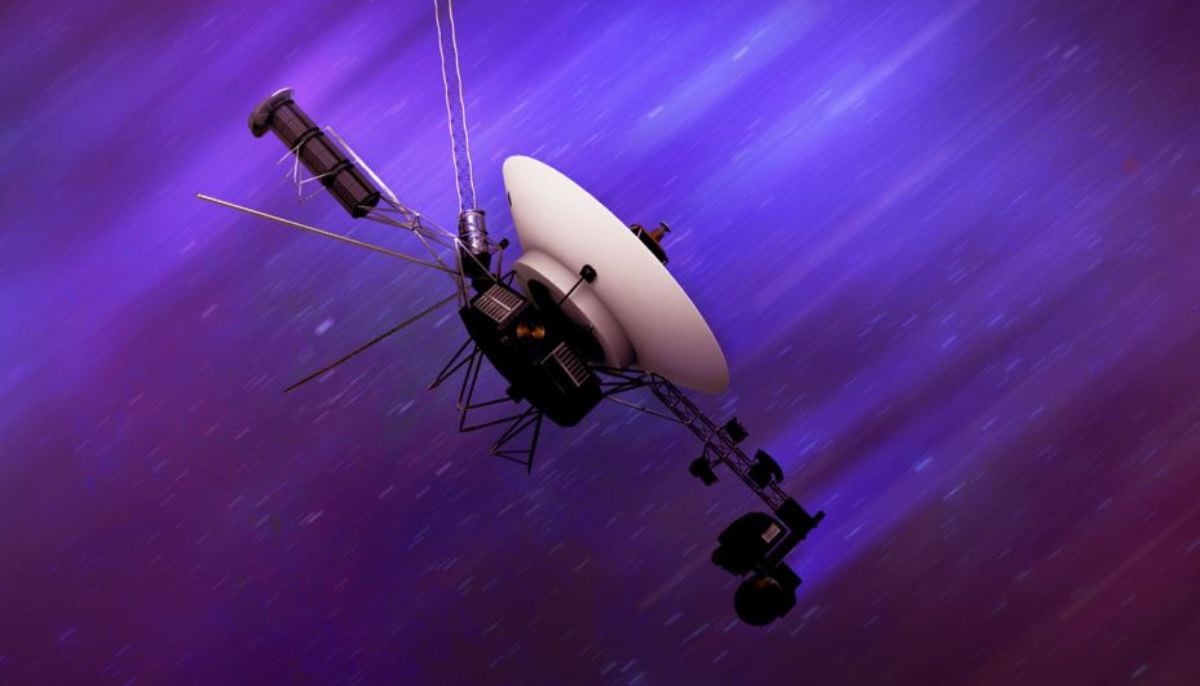
NASA’s Jet Propulsion Laboratory (JPL) has deactivated the Low-energy Charged Particles (LECP) experiment on Voyager 1. The shutdown was necessary due to the spacecraft’s dwindling nuclear power supply, with the aim of extending the probe’s operational life in interstellar space.
The LECP had operated almost continuously for almost 49 years and had been active since the spacecraft’s launch in 1977.
The move was driven by the dwindling supply of nuclear-powered spacecraft, with mission managers adding that disabling the LECP was the best way to keep the probe operational.
The instrument is designed to monitor ions, electrons and cosmic rays from both our solar system and the wider galaxy.
As the furthest probes from Earth, the twin Voyagers are the only unique instruments capable of collecting this particular class of interstellar data.
“While it is no one’s preference to turn off a scientific instrument, it is the best option available,” said Kareem Badaruddin, Voyager mission manager at NASA’s Jet Propulsion Laboratory in Pasadena, California.
“Voyager 1 still has two remaining operational science instruments: one that listens for plasma waves and one that measures magnetic fields. They are still working very well, sending back data from an area of space that no other human-made spacecraft has ever explored. The team remains focused on keeping both Voyagers going as long as possible.”
It provided essential data on the interstellar medium, in particular detecting pressure fronts and variations in particle density outside the heliosphere.
The closure was not an emergency response, but followed a pre-planned hierarchy designed to preserve critical scientific instruments. Currently, two of the original instrument sets remain active on Voyager 1.
According to engineers, the closure of the Low-energy Charged Particles experiment will allow Voyager 1 to continue flying with the remaining functional instruments for about a year.
This move follows a similar closure of the LECP on Voyager 2 in March 2025. These sacrifices are part of a broader strategy to keep Voyager 1 functional as it continues its journeys deeper into the interstellar void.
By expanding the mission in this way, Voyager 1 could reach its 50th anniversary in 2027. Consequently, Voyager 1 remains the farthest spacecraft ever built, traveling further from the sun every year.