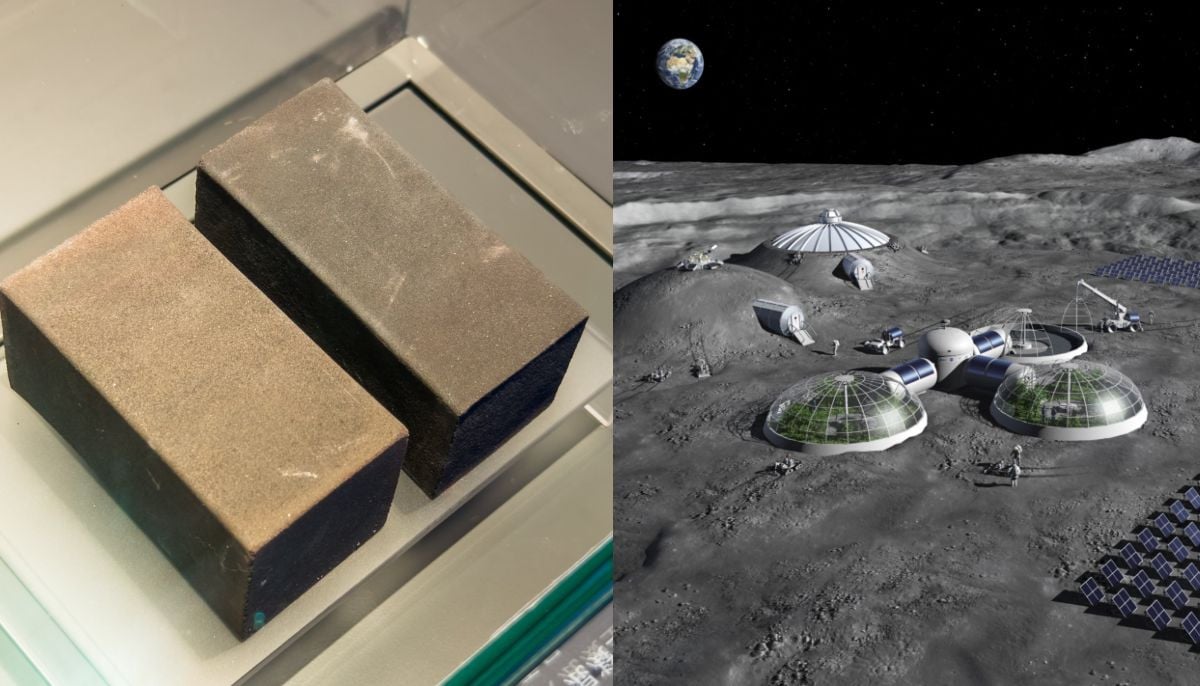
China has moved closer to building the world’s first moon base as the first batch of experimental ‘moon ground bricks’ returned to Earth in a major breakthrough.
These foundation stones were preserved in the harsh conditions of space during an experimental trial as part of the creation of the Chinese space station.
According to researchers’ findings, after surviving the harsh conditions of deep space, these moon rocks offer promising hope for future lunar base construction plans.
These findings could help predict how these rocks will break down on the moon’s surface in five, ten or even twenty years, bringing China’s vision for its ‘Guanghan Palace’ closer to reality.
Zhou Yan, an associate professor at Huazhong University of Science and Technology in Wuhan, said: “When we opened the lid, we found that the samples were in good condition. There were no dents, holes or other visible defects that we thought they might have due to meteorite impacts or space debris.”
“In addition, their colors looked slightly lighter than before. Further assessments are needed to determine the reason,” he added.
These 34 blocks returned to Earth last week with the Shenzhou-21 spacecraft. Each block weighs approximately 100 grams, which shows the composition of lunar rigolite.
These moon rocks will reduce the acquisition costs of setting up lunar bases by relying on in-situ resources, including solar energy, lunar soil and surface minerals.
As the space war intensifies with the US Artemis II program, China is also pursuing its lunar program ambitions to land astronauts on the moon by 2030.
It also plans to establish the International Lunar Research Station by 2035.