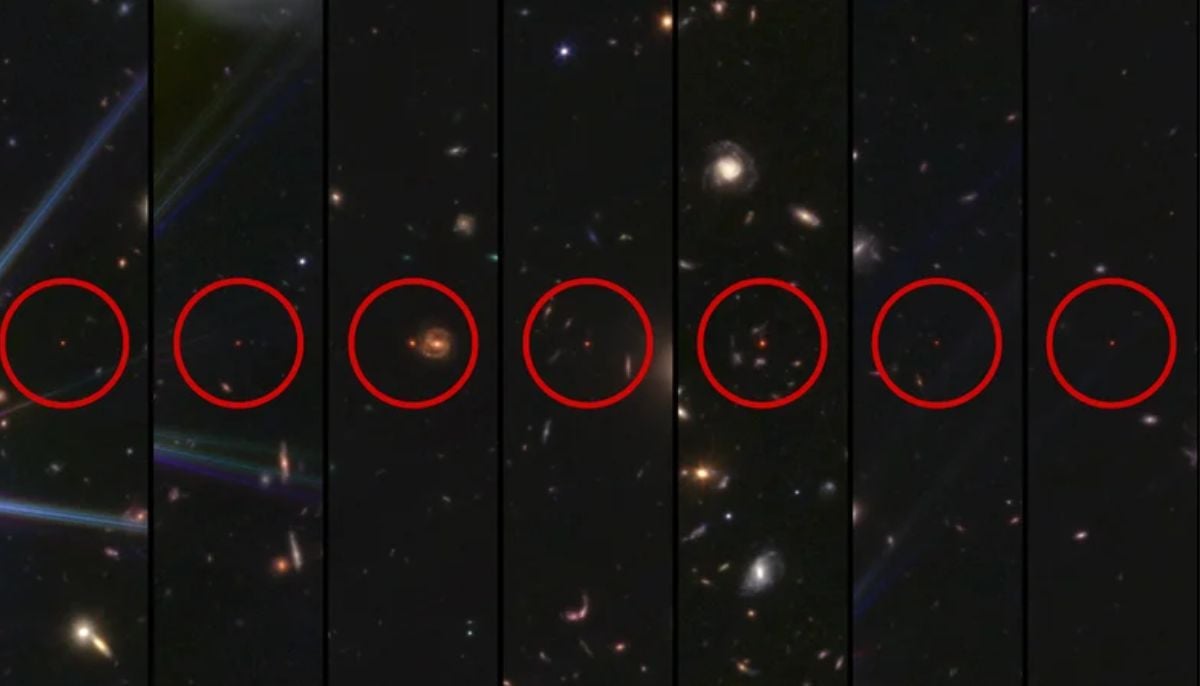
Scientists recently announced a solution to the mystery of the ‘little red dots’ first spotted by the James Webb Space Telescope in 2022.
This is evident from a large study published in the Journal Nature on January 14, researchers showed that these dots are not massive galaxies, but rather young supermassive black holes obscured by dense gas. Researchers found that the objects that confused their unusual light obscured the source of their power.
However, previous studies suggest that these ‘little red dots’ are extremely compact and appeared during the earliest stages of the universe’s history.
How light from early galaxies is spread across the spectrum
James Webb’s advanced instruments helped to precisely investigate how the light from the galaxies is distributed among different colors. They discovered that light is scattered by dense, ionized gases, a process that only occurs near a black hole that is gathering material.
Observations show that as the gas falls toward a black hole, it heats up and shines through the surrounding gas cocoon, creating the characteristic red glow.
The new study further suggests that the black holes have a mass between 100,000 and 10 million times that of that sun.
Although they are enormous, they are much smaller than previously thought: the lowest-mass black holes known in the early universe. The tiny dots are essentially young black holes caught in a previously unnoticed growth spurt.