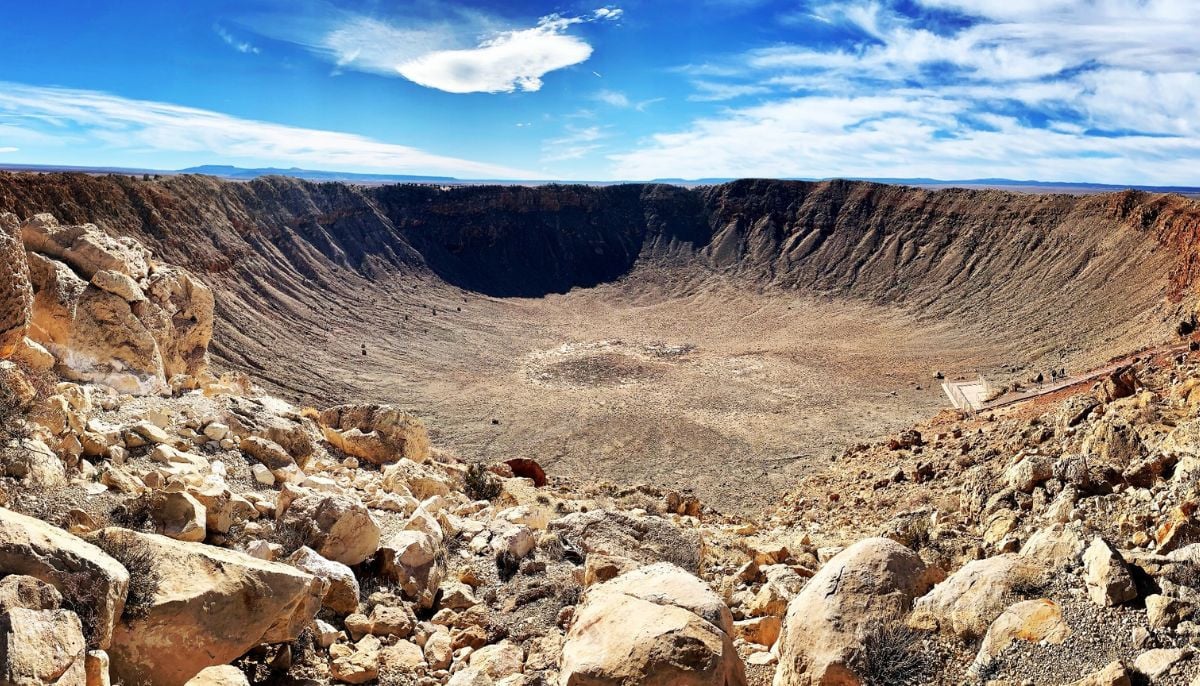
Arizona’s Meteor Crater remains the best-preserved meteorite impact site on Earth. Despite being studied for more than a century, recent scientific research in 2025 and 2026 has uncovered surprising new secrets about the enormous scale of its impact and its role in future space exploration. It represents the best preserved meteor impact site in the world, with a depth of about 700 feet, a diameter of more than 4,000 feet and a circumference of 2.4 miles.
Features like Meteor Crater remain ongoing research sites, generating new data about what happens when objects from the cosmos impact our planet. A number of competitive grants are currently being offered to support field research at known impact locations worldwide. According to scientist Dan Durda, the site is described as a perfect natural laboratory because it is a well-preserved and exposed impact crater on Earth.
The Barringer Crater Company has established grants specifically for students and early researchers to study terrestrial craters. These grants are intended to deepen our understanding of cratering and encourage the next generation of scientists to pursue this specific branch of research.
Meteor crater: a high-energy geological event that still yields secrets
Impact craters are described as a high-energy geological event that occurs over a very short period of time and creates conditions that exceed the intensity of nuclear explosions. Scientists use morphological and geophysical surveys to find anomalous structures underground. The main motive for recognizing an impact site requires evidence of shock metamorphic efforts or the presence of meteoritic components that only occur during hypervelocity impacts.
There are currently approximately 200 confirmed impact craters on Earth. The study of these sites has become an important interdisciplinary impact bridging several scientific fields. The Barringer Family Fund offers grants to young researchers worldwide to encourage new studies, with an annual deadline of April 1.