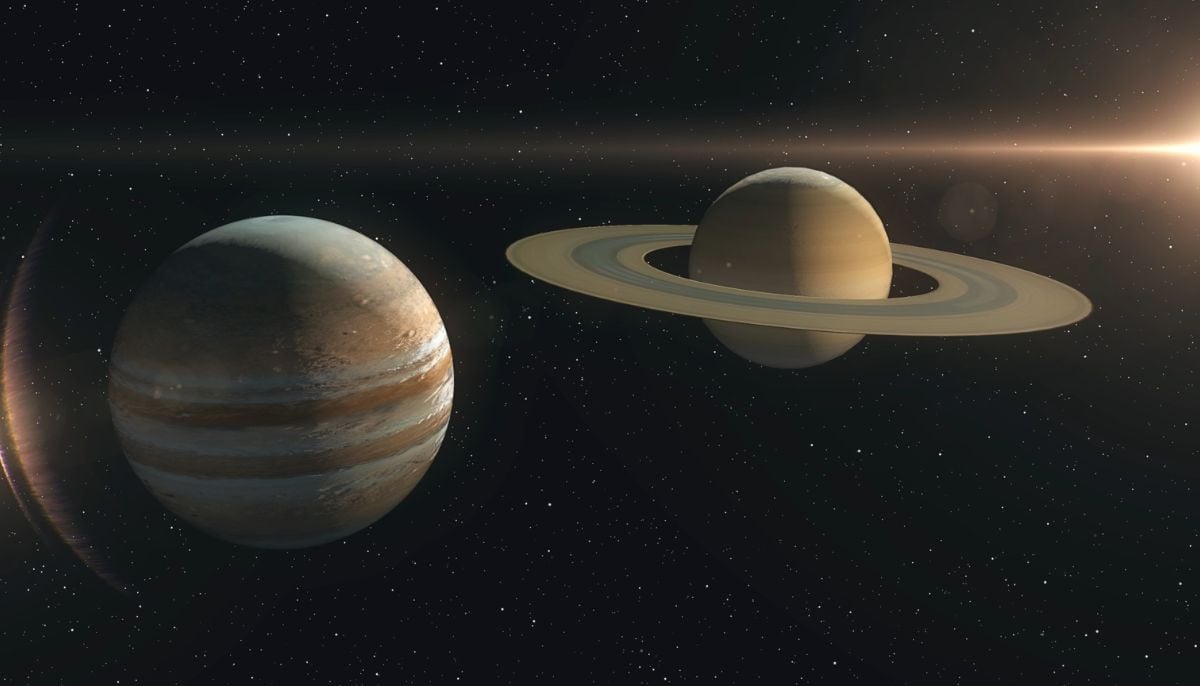
Most people don’t understand that the solar system contains more objects than they usually expect. Scientists have confirmed for years that Jupiter and Saturn possess several natural satellites, but recent research has uncovered many unknown celestial bodies.
The latest survey revealed 15 additional moons, bringing Saturn’s moon count to 285 and Jupiter’s total to 101, while the total number of moons in the solar system reached 442 known moons.
The new moons of Jupiter and Saturn
The newly found moons have a diameter of less than 3 kilometers, making them one of the smallest moons discovered. The small moons orbit their parent planets at distances greater than the standard range of the main known moons, reducing their brightness so much that backyard telescopes cannot detect them.
Their brightness is between magnitude 25 and 27, compared to Earth’s moon at magnitude -12.6. Scott Sheppard and David Tholen discovered Jupiter’s four new moons using powerful telescopes in Chile and Hawaii.
The discovery of 11 new moons orbiting Saturn was made by Edward Ashton and his research team, using a telescope in Hawaii. The team of astronomers has discovered more than 200 moons spread throughout the solar system.
Jupiter currently has 101 moons, but Saturn has 285 moons, and the upcoming Europa Clipper and JUICE missions, due to arrive in the early 2030s, are likely to discover even more moons. Earth has one moon, while Mars has two moons, Uranus has 28 moons and Neptune contains 16 moons, and Venus and Mercury have no moons.