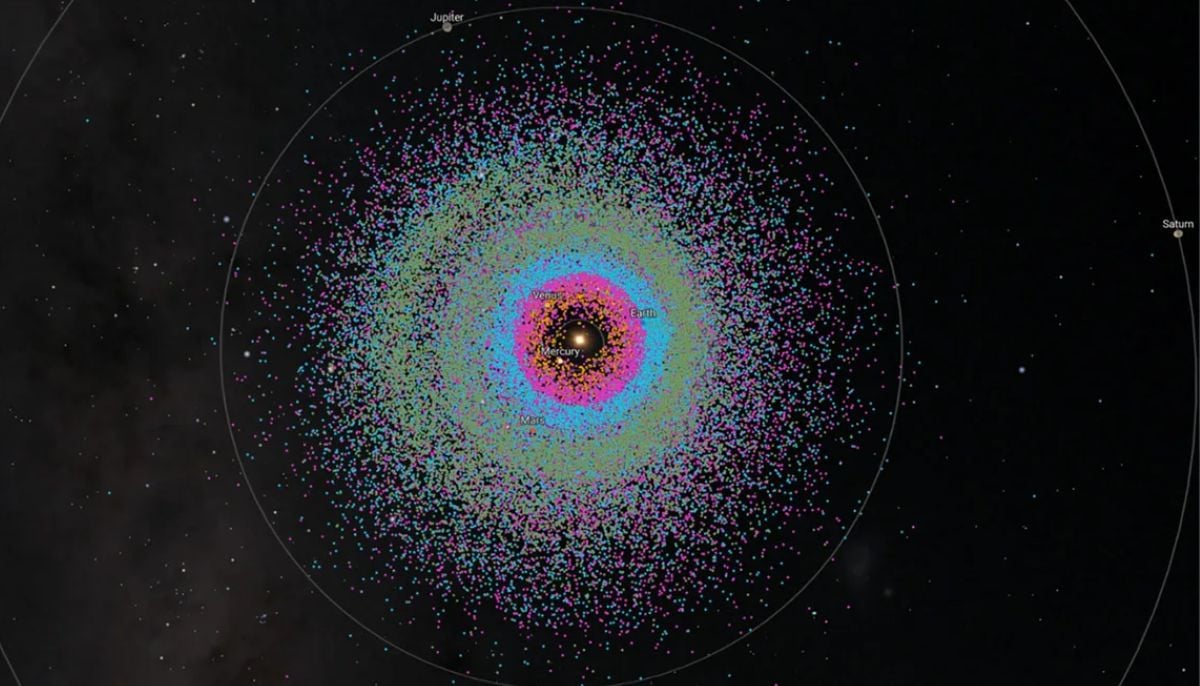
A surprising discovery has been unveiled by astronomers as they classified the 40,000th near-Earth asteroid.
The recent announcement marks a major milestone in the detection of space rocks orbiting close to Earth, and scientists underscore the threat that space rocks pose to our home planet.
According to the BBCthe near-Earth asteroids may be only a few meters to a few kilometers in diameter and travel in orbits that bring them relatively close to Earth.
The recent development is generating tremendous interest among scientists and planetary defense experts alike.
Why do we look at asteroids that are close to Earth?
An asteroid is a remnant left over from the formation of the solar system more than 4 billion years ago. It has been observed that most of the asteroids in our solar system are located in the main asteroid belt between Mars and Jupiter.
An asteroid near Earth has an orbit that brings it within about 28 million miles of Earth’s orbit.
The dedicated asteroid survey telescopes increased the total number of known nearby space rocks in the 1990s and 2000s.
The year 2025 is famous because the number of asteroids near Earth has exceeded 40,000, of which about 10,000 have been found in three years.
A stream of discoveries
The number of discoveries is expanding aggressively, from a thousand at the beginning of this century to 15,000 in 2016 and 30,000 in 2022.
Once a discovery is made, scientists try to analyze its path using all the data collected about the objects in various observatories.
The computer software is used to analyze an asteroid’s orbit, even decades into the future, to show what is likely to hit Earth.
Paving the way for new challenges
The European Space Agency (ESA) claimed that the largest asteroids near Earth are the easiest to detect. This revelation would cause global damage if it hits Earth, but scientists are confident the vast majority have already been discovered.
The current focus is on the medium-sized objects, which are 100-300 meters wide and are difficult to spot but can cause regional damage.
The frequent analysis of data by scientists will help to learn more about these nearby space rocks as this research provides a crystal clear picture of the potential threat to our planet and how we can protect ourselves.