This year, NASA unveiled new discoveries beyond our solar system. The number has passed 6,000, with several thousand more awaiting confirmation.
This recent milestone comes just thirty years after the Nobel Prize-winning discovery of the first planet orbiting a Sun-like star in 1995.
As the year draws to a close, here’s a look back at some of the most intriguing and rule-breaking exoplanets astronomers discovered in 2025.
New Circumbinary Planets Discovered in 2025
Tatooine-like worlds jumped from science fiction to the exoplanet database this year as astronomers analyzed multiple planets orbiting two suns — sometimes in configurations that challenge the primary rules of planetary formation.
Located about 120 light-years from Earth as the world orbits above and below the poles of its two stars.
The team made the intriguing discovery that inferred the planet’s presence using a large telescope in Chile after detecting an unusual backward wobble in the brown dwarf’s orbit.
The independent teams identified HD 143811 (AB), a giant planet that had been hidden in archival data for years. Photographed by the Gemini Planet South telescope in Chile; the world revolves around a young binary star system about 446 light-years from Earth.
K2-18b: the loudest exoplanet of 2025
The exoplanet K2-18b became a focus of research in 2025 after possible signs of life sparked scientific debate.
In particular, researchers emphasize that K2-18b remains a valuable target for understanding sub-Neptunes, a class of planets absent from our solar system.
The analysis further led to interpretations that one group believed that non-biological gases, including propyne, could reproduce the same spectral features, while another group concluded that the JWST signal was too noisy to draw a definitive conclusion.
The JWST observations indicated methane in the planet’s atmosphere, raising the possibility of complex or even biological activity.
Computer simulations further showed that any methane on TRAPPIST-1e would be immediately destroyed by intense ultraviolet radiation that survived only about 200,000 years – not long enough for it to be replenished by geological degassing.
Proxima Centauri: An intriguing new look at our nearest neighbor
In 2025, astronomers developed a sharper perspective on Proxima Centauri, the Sun’s closest stellar neighbor, located just 4.2 light-years away.
This was made possible by a powerful new instrument designed to chase small and cool stars around the world.
The Near-Infrared Planet Searcher (NIRPS) also confirmed a smaller planet, Proxima d, which helped rule out a previously claimed third world, refining the count of the nearest planetary system.
The results marked a major milestone as astronomers achieved the accuracy needed to analyze the weak gravity of rocky planets around red dwarf stars, which emit most of their light in the infrared.
The planetary system around Proxima Centauri represents our best opportunity to study planets around dwarf stars and provides an ideal target in the search for life beyond our solar system.
The lava world that refuses to be made barren
Astronomers using the JWST discovered that an atmosphere clung to a planet against all traditional rules.
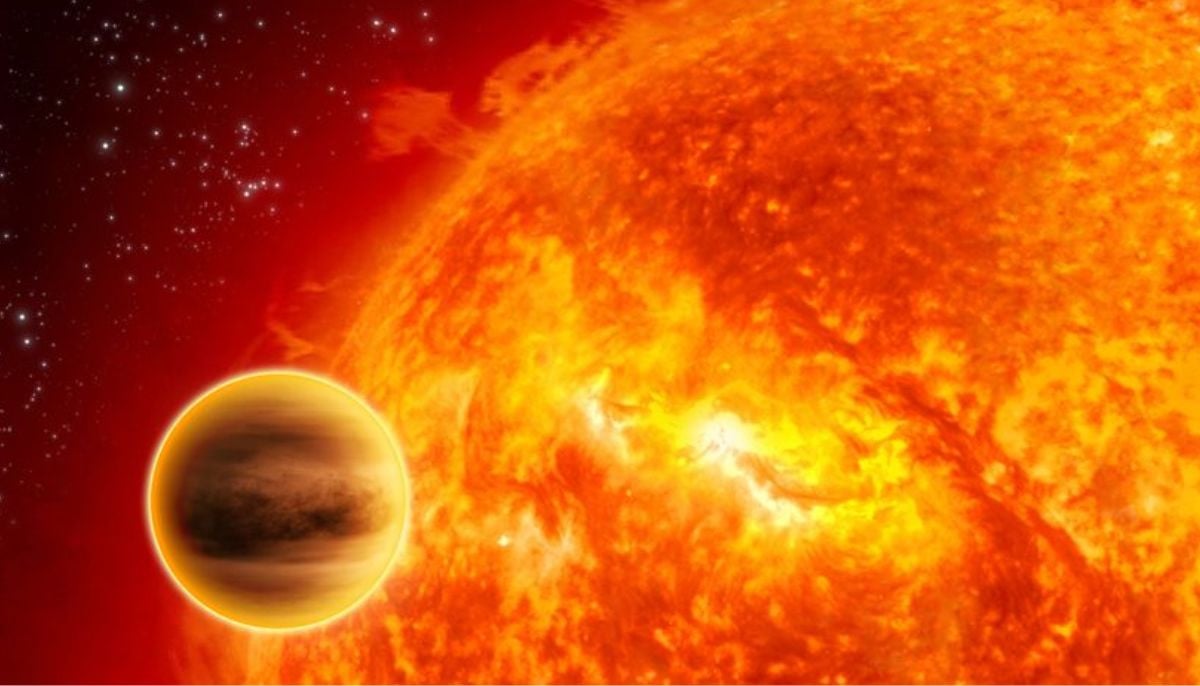
The world, TOI-561b, is a small, scorching lava planet that orbits so close to one of the oldest stars in the Milky Way that its year is less than a single Earth day.
Meanwhile, JWST observations suggest the planet’s dayside is cooler than expected for a bare and airless rock, as the presence of a notable atmosphere may have lasted billions of years.
The recent findings suggest that the evidence for a long-lived atmosphere is not only present, but also challenges extreme assumptions about how atmospheres survive under such harsh conditions.
Two cosmic moments that shaped our universe in 2025
Astronomers have spotted a plant located about 437 light-years from Earth. The newborn world WISPIT 2b is only a million years old and is already about five times more massive than Jupiter.
Researchers have long suspected that such holes mark the presence of newborn planets, but this is the first time images have emerged directly from its orbit.
The telescopes in Chile and Hawaii detected heavy elements recently deposited on the white dwarf’s surface.
Consequently, the findings suggest that gravitational forces that change as the stars evolve can destabilize the surviving planets.
This year concludes with one of the most transformative periods for exoplanet research, going beyond just finding new worlds and characterizing them in depth.