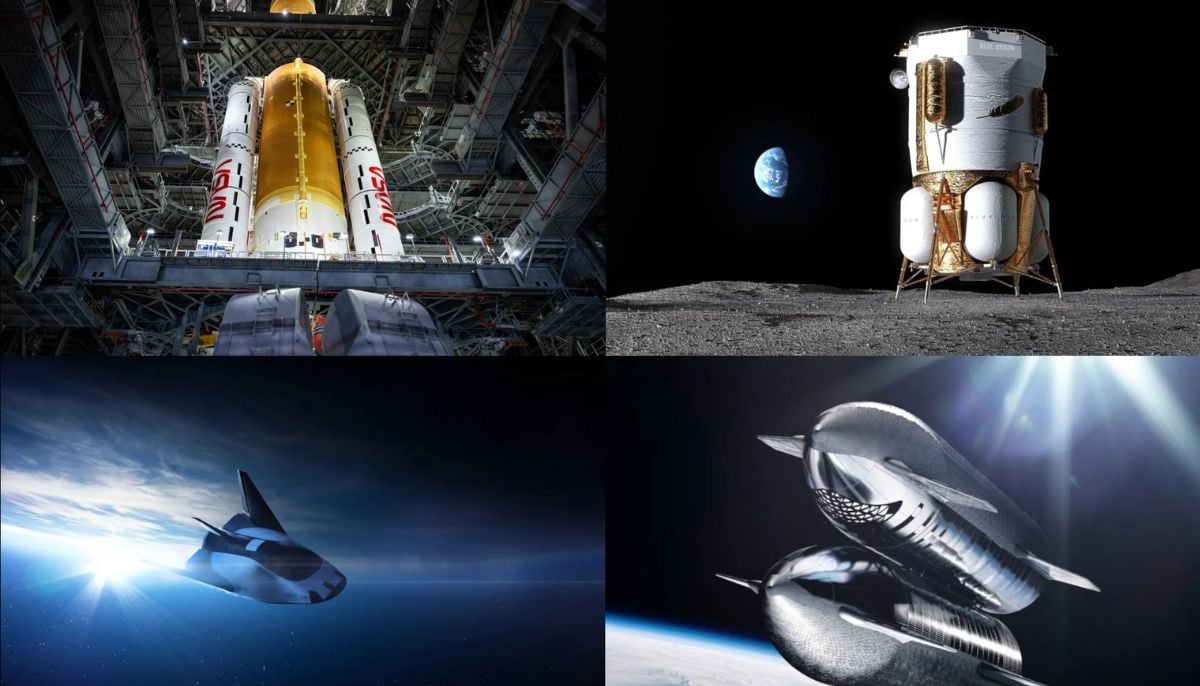
The new year is just around the corner; It marks a promising year for space exploration. After years of travel and preparation, humanity will return to the lunar environment in 2026 and witness a major breakthrough on the innermost planet of the solar system.
In the first part of the year, four astronauts will orbit the moon for the first time since the Apollo missions of the late 1990s and early 1970s.
Meanwhile, anticipation is high for the upcoming Chinese mission, which aims to explore the moon’s shadowy places to look for resources that could one day help life flourish there.
The European Space Agency (ESA) is reportedly working on launching a mission to determine whether humans can defend Earth from asteroids.
NASA’s Artemis II will send four astronauts into orbit around the moon
2026 marked the “Year of the Moon” for two main reasons. The first is the Artemis II mission, which will carry three American astronauts and one Canadian on a 10-day flight around the moon.
The crew will travel approximately 7,600 kilometers beyond the far side of the moon, giving them a unique vantage point to see Earth and the moon at the same time.
China marks a major milestone with a mission to the moon’s south pole
The buzz around 2026 moon missions remains strong, especially since one mission uses a “hopper spacecraft” designed to hop from sunlit areas to permanently shadowed craters.
In this regard, Chang’e-7 deputy chief designer Tang Yuhua told the media that finding ice at the moon’s south pole could significantly reduce the cost and time needed to transport water from Earth.
China hopes the mission will eventually lead to several breakthroughs, such as using artificial intelligence to explore the moon’s difficult polar regions.
Planetary defense through crash scene investigation
In a major step, the European Space Agency (ESA) is exploring asteroids in an effort to improve Earth’s defenses against future objects that could hit our planet.
To achieve this, ESA launched a spacecraft in 2024 to closely examine the impact site of an asteroid that struck the United States in 2022.
The primary goal of this mission is to understand how effectively spacecraft can protect Earth from incoming objects.
The data from ESA’s Hera mission will help scientists refine asteroid deflection technology so that we are prepared if a threat arises in the future.
Measuring the invisible shield around the Earth
In April or May, European and Chinese scientists will launch a mission to capture detailed X-ray images of Earth’s magnetosphere.
This magnetic field protects the Earth and its inhabitants from the solar wind, a stream of charged particles that flows from the sun.
The spacecraft will travel up to 121,000 kilometers above the North Pole and cover almost a third of the distance to the moon.
A mission to mercury
For the first time, orbiters from Europe and Japan will enter orbit around Mercury – a difficult feat because the sun’s enormous gravitational pull makes it difficult to slow down.
Once in position, these orbiters will capture crucial data about the planet’s magnetic environment and produce the most detailed global maps of Mercury’s surface to date.
These missions set the stage for a year that marks the transition from robotic exploration to the return of human presence in deep space.