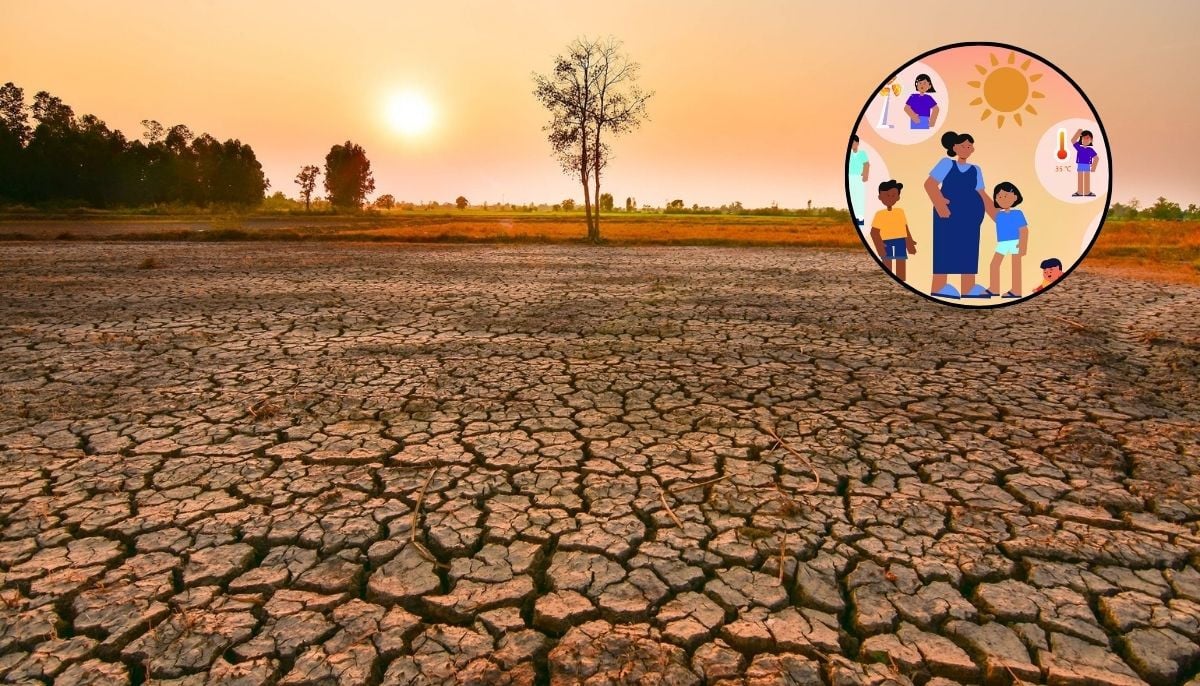
The world is about to witness new, harsh realities of climate change as scientists warn that El Nino may return this year, sending global temperatures to record highs.
According to the US National Oceanic and Atmospheric Administration (NOAA), there is a 50 to 60 percent chance that the disease will develop during the July-September period and beyond.
But NOAA warns that the accuracy of the forecast is significantly low, as this is far too early to predict El Nino in 2026.
What is El Nino?
In climatology, El Nino is one of the important events responsible for changing the weather patterns. When we talk about El Nina, the name of her cooler sister, La Nina, also comes into play.
Think of El Nino (the boy) and La Nina (the girl) as the Earth’s way of “sloshing” warm water back and forth across the Pacific Ocean, known as the El Nino-Southern Oscillation (ENSO).
_updates.jpg)
Normally, strong winds blow from America towards Asia, maintaining warm water in the west and cool water in the east. When this balance is disrupted, weather patterns change around the world.
El Nino occurs occasionally, about every 2 to 7 years, and typically lasts for a year or more. El Nino is followed by La Nina and there is a “neutral” phase between these two events.
What happens in El Nino and La Nina?
El Nino occurs when the usual winds weaken or start blowing in the opposite direction. As a result, the eastern Pacific becomes much warmer than normal, leading to heavier rainfall in the Americas and droughts in Australia and Indonesia.
_updates.jpg)
During La Nina, the normal east-west trade winds are boosted and blow much harder than towards Asia, pushing the warm water further west towards the coasts of Australia and Southeast Asia.
As a result, cold water from the deep ocean rises to fill this gap, which it calls upwelling. Therefore, the Pacific Ocean becomes much colder than normal.
The southern US experiences drier conditions and heavy rains become common in Asia.
Rise in global temperatures
El Nino also intensifies the heat wave in the tropics. According to the predictions of some meteorologists, a typical El Nino event could cause a temporary increase in global average temperature by 0.1-0.2℃.
The last El Nino occurred in 2023-2024, making 2023 the second highest year on record and putting 2024 at the top.
Carlo Buontempo, director of the European Union’s Copernicus Climate Change Service, said “2026 could be another record year” if El Nino appears this year.
But when it is released later this year, the world will experience the worst impacts in 2027, said Tido Semmler, a climate scientist at Ireland’s National Meteorological Service.
Jennifer Francis of the Woodwell Climate Research Center claims, “If El Niño develops, we will likely set a new global temperature record.”
Method to calculate El Nino and La Nina
In February, NOAA adopted a new method to determine El Nino and La Nina events. The old methodology consisted of the old Oceanic Nino Index (ONI), which measures sea surface temperature anomalies against a fixed 30-year historical average.
The new method, the Relative Oceanic Nino Index (RONI), compares the temperatures of the east-central Pacific Ocean with the current average temperatures of the rest of the tropics, making it a “more reliable way.”