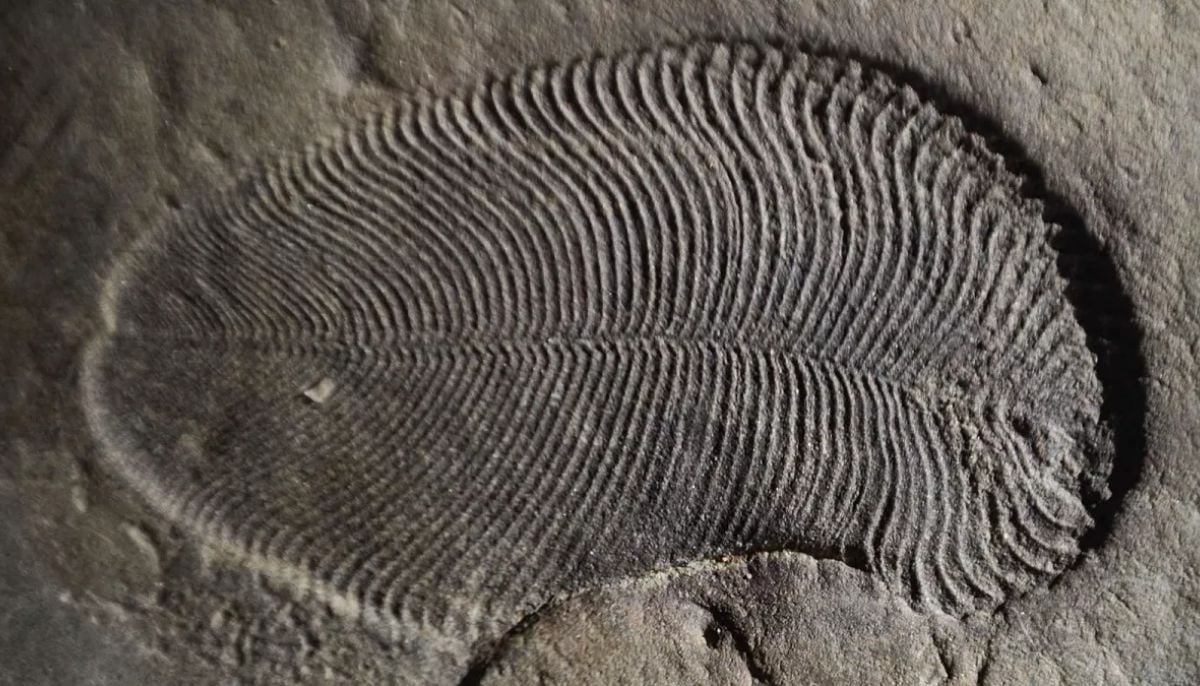
A 550-million-year-old marine sponge fossil discovered in China is helping scientists solve a 160-million-year gap in the early history of animal life. The finding provides exceptional physical evidence that scientists thought had disappeared from the fossil record of this bygone era before new evidence emerged about the evolutionary development of ancient sponges.
The discovery, published in Nature by researchers from Virginia Tech and Shuhai Xiao, establishes a clear link between the fossil and the period that scientists call the ‘lost years’ of sponge evolution.
After an employee sent an image to Xiao, the fossil became visible for the first time along the Yangtze River in China. The unusual structure of the object led to several institutions investigating the matter, including the University of Cambridge and the Nanjing Institute of Geology and Paleontology.
The researchers eliminated all possibilities that the specimen resembled sea squirts, anemones and corals before determining it was an ancient sponge. The specimen measures approximately 15 inches and exhibits a complex conical structure with a unique grid pattern covering its surface.
The structure suggests a close relationship to modern glass sponges, but its size and complexity surprised scientists. Researchers expected early sponges to be much smaller and simpler in shape.
One of the main theories explaining the long interval without fossil evidence is that the first sponges did not form skeletal parts from minerals. So they would hardly be able to maintain themselves in fossils because of their softness.
This research strengthens previous studies suggesting that the evolution of sponge spicules was characterized by increased mineralization throughout the process. Therefore, if only soft sponges existed in the early stages, few specimens would be preserved in the rocks.
Modern scientists argue that the early evolution of animals within the paleontological record could be underestimated due to the lack of fossils, caused by preservation bias and not by its non-existence.